Question Types
IELTS Listening Map Labelling: Tips, Strategy and Practice
Learn how to tackle IELTS Listening map labelling questions with a proven strategy, realistic examples and tips to avoid common mistakes.
Pandawise AI · Updated · 8 min read
In this guide
Map labelling questions in the IELTS Listening test ask you to follow a speaker’s description of a place and label a map, plan or diagram. You might need to write a letter from the map (A–H) next to a question, or write a word for a labelled place. These questions test your ability to understand directions, locations and spatial relationships. In this guide, you will learn exactly what IELTS Listening map labelling involves, see a realistic example, follow a step‑by‑step strategy and discover the most common traps.
What are IELTS Listening map labelling questions?
IELTS Listening map labelling questions appear in Part 2 of the test. Part 2 is a monologue on an everyday social topic, such as a tour of a museum, a description of a new sports centre or a walk through a park. The speaker gives directions or describes the layout of a place, and you must label the visual.
There are two main types:
- Write the correct letter – the map has several points marked with letters (A, B, C, etc.). You choose the letter that matches each question.
- Write a word or short phrase – the map has blank spaces next to features or rooms. You write the name of the place you hear.
Both types follow the same principle: the questions follow the speaker’s route in order. You will always start from a clear starting point – often the entrance or a place marked ‘You are here’. Look for a compass or an arrow showing north; if there is no compass, the speaker will use words like left, right, in front of and behind from the viewpoint of someone walking through the space.
What do the questions look like?
Before the recording begins, you will see a map or plan and a set of questions. The instruction line tells you the word limit. For map labelling with letters, the instruction is usually:
Write the correct letter, A–H, next to Questions 1–5.
For word‑based labelling, you might see:
Write ONE WORD ONLY for each answer.
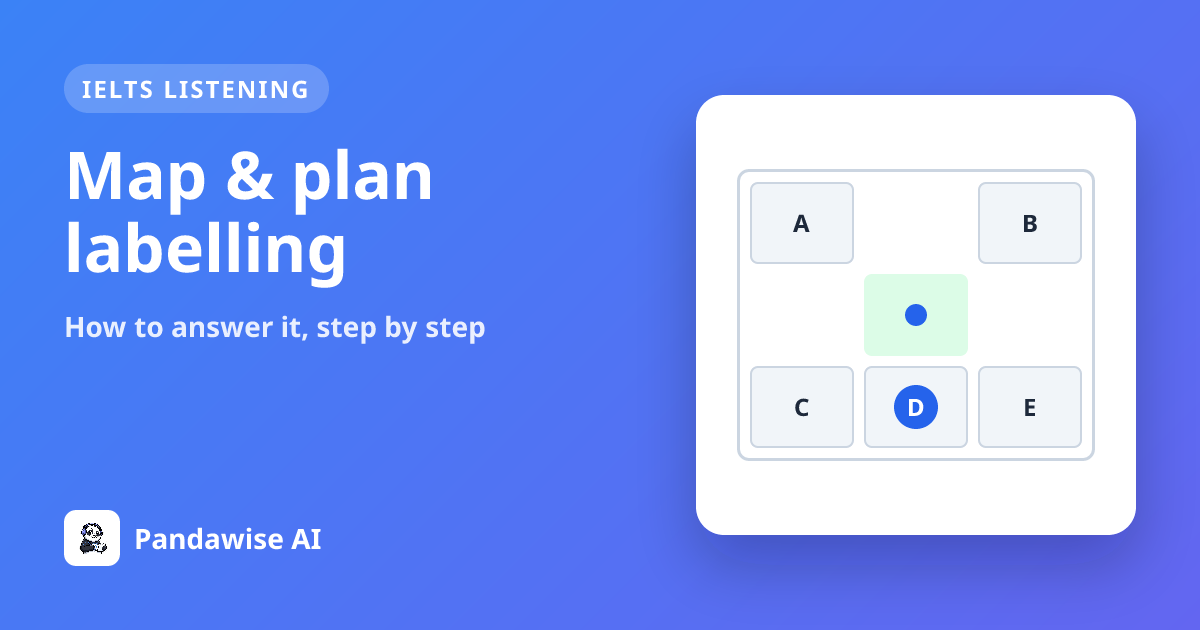
Below is a realistic example of a plan labelling task. Imagine a floor plan of a community centre. The entrance is at the bottom. Rooms are marked A–H on the plan. The questions ask you to match five facilities to the correct letter.
| Question | Facility |
|---|---|
| 1 | Main hall |
| 2 | Kitchen |
| 3 | Crèche |
| 4 | Office |
| 5 | Storeroom |
You would see a plan with letters A–H placed in different rooms. Your task is to write the letter that matches each facility.
Step‑by‑step strategy for map labelling
A clear strategy helps you stay calm and follow the speaker’s route. Here is what to do before, during and after the recording.
Before the recording
- Study the map quickly. Find the starting point – look for ‘You are here’, an entrance or an arrow. Check for a compass. If there is a compass, note where north, south, east and west are. If not, the directions will be relative to the path you take.
- Look at the letters or gaps. Read all the labels already on the map. These are fixed points the speaker will use to guide you. Say them quietly in your head so you recognise them when you hear them.
- Read the questions. Underline the key words in each question. For example, in the table above, underline Main hall, Kitchen, Crèche, Office and Storeroom. Think about what these words sound like – the recording will often paraphrase them.
- Predict the route. The speaker usually moves in a logical order – perhaps clockwise around a building, or from the entrance to the back. The questions follow that order. Question 1 will be near the start of the tour, Question 5 near the end.
While listening
- Follow with your pencil or finger. As the speaker describes the route, move your finger on the map. Stay with the speaker – if you fall behind, you may miss several answers.
- Listen for signpost words. The speaker uses phrases like The first room on your left is…, Opposite the entrance you’ll see…, If you go past the café, the next door is… These tell you that an answer is coming.
- Watch out for corrections. The speaker often says one thing and then changes their mind. For example: The office used to be in Room C, but now it’s moved to Room E. The correct answer is the final version – Room E.
- Write answers as you go. Do not wait until the end. Write the letter or word immediately, then move your eyes to the next question.
After the recording
- Check your answers. In the paper test, you have 10 minutes to transfer answers to the answer sheet. Use this time to check spelling and that you have followed the word limit. In the computer test, you have 2 minutes to review.
- Guess if necessary. There is no penalty for wrong answers, so never leave a blank.
Worked example: community centre plan
Below is the transcript for the questions in the table above. The speaker is a receptionist showing a new volunteer around the community centre.
Receptionist: Right, let me show you around. We’re standing at the main entrance. Directly in front of you, at the end of the corridor, is the main hall – that’s Room A. It’s the largest space we have. Now, if you turn left here, you’ll see the kitchen on your right, just past the noticeboard. That’s Room C. Actually, sorry – the kitchen used to be there, but we’ve just moved it to the other side, next to the back door. So the kitchen is now Room E. Opposite the kitchen, across the corridor, is the crèche. You can’t miss it – it has a bright yellow door. That’s Room F. Next, let’s walk back towards the entrance. On your left, just before you reach the main doors, is the office. It’s a small room, Room B. Oh, and one more thing – the storeroom is behind the office. You have to go through the office to reach it. That’s Room D.
Now let’s find each answer and explain the clues.
Question 1: Main hall
The speaker starts at the entrance and says Directly in front of you, at the end of the corridor, is the main hall – that’s Room A. The paraphrase is simple: main hall is the exact phrase from the question. The answer is A.
Question 2: Kitchen
The speaker first says the kitchen is Room C, then corrects herself: Actually, sorry – the kitchen used to be there, but we’ve just moved it… So the kitchen is now Room E. The trap is Room C. The correct answer is E.
Question 3: Crèche
After the kitchen, the speaker says Opposite the kitchen, across the corridor, is the crèche… That’s Room F. The word crèche matches the question exactly. The answer is F.
Question 4: Office
The speaker walks back towards the entrance: On your left, just before you reach the main doors, is the office… Room B. The direction phrase on your left and the position just before the main doors point to Room B. The answer is B.
Question 5: Storeroom
Finally, the storeroom is behind the office. You have to go through the office to reach it. That’s Room D. The preposition behind and the extra detail go through the office confirm Room D. The answer is D.
Common mistakes and traps
- Losing your place on the map. If you stop to think about one answer, the speaker moves on. Always keep your finger moving. If you miss one, guess quickly and refocus.
- Falling for corrections. As in the kitchen example, speakers often change their mind. The first answer is a distractor. Always wait for the final statement.
- Confusing similar‑sounding letters. Letters like B, D, E and C can sound alike on a recording. Use the context – if the speaker says behind the office, check which room is behind the office on the map.
- Ignoring the compass. If a compass is present, the speaker will use north, south, east and west. Practise directions vocabulary IELTS such as north-east corner, southern wing and clockwise from the entrance.
- Not noticing paraphrases. The question might say car park, but the speaker says where you leave your vehicle. Build your vocabulary for common map features: path, footbridge, pond, fountain, lobby, corridor, staircase.
- Writing more than the word limit. If the instruction says ONE WORD ONLY, swimming pool is wrong; you must write pool (if that is what the speaker says). Always check the limit.
How to practise map labelling
Regular, focused practice makes a big difference. Here are some concrete exercises.
- Draw and describe. Take a simple map of a park, shopping centre or museum. Describe a route to a friend using directions vocabulary IELTS: go straight on, take the second left, it’s opposite the fountain. Then swap roles.
- Transcribe short sections. Find a practice recording with map questions. Listen to 30 seconds and write down every direction word and preposition you hear. This trains your ear for signpost language.
- Predict the route. Before you listen, look at the map and guess the order the speaker will follow. After listening, check if you were right. This builds your ability to follow a logical path.
- Practise with distractions. Play a recording in a slightly noisy environment. This helps you stay focused on the speaker’s voice when you are in the real test room.
- Use official‑style materials. Work with realistic map and plan tasks. For structured practice with instant feedback, try IELTS Listening lessons on Pandawise AI.
For more help with other question types, read our guides on all IELTS Listening question types: an overview of the test and of each type, with how to approach it, IELTS Listening diagram labelling questions and IELTS Listening matching questions.
Key takeaways
- IELTS Listening map labelling questions are usually in Part 2 and follow the speaker’s route in order.
- Always find the starting point and check for a compass before the recording begins.
- Listen for signpost words like opposite, next to, past and between – they signal an answer is near.
- Beware of corrections; the speaker’s final statement is the correct answer.
- Keep your finger moving on the map and never leave a blank – guess if you fall behind.
- Build your directions vocabulary IELTS and practise with realistic maps regularly.
Practise map & plan labelling questions
Exam-style lessons and practice tests with real audio, instant marking and an explanation for every answer.
Explore the appFrequently asked questions
What is the difference between map labelling and plan labelling in IELTS Listening?
Map labelling usually involves an outdoor area like a park or campus, while plan labelling shows the inside of a building such as a library or community centre. Both question types work the same way: you follow a speaker’s directions and label locations using letters or words. The skills tested are identical, so you can prepare for them together.
How can I improve my directions vocabulary for IELTS Listening map questions?
Make a list of common direction words and prepositions: opposite, next to, between, behind, in front of, past, turn left/right, go straight on, clockwise, north/south-east. Practise using them by describing routes on real maps. Listen to guided tours or audio descriptions of places and note how the speaker uses spatial language.
Why do I always get lost during map questions in IELTS Listening?
Most candidates get lost because they stop to think about one answer and the speaker moves on. Keep your finger or cursor moving on the map as you listen. If you miss an answer, take a quick guess and immediately refocus on the next question. Practice with a clear strategy will help you stay on track.
Are map questions always in Part 2 of the IELTS Listening test?
Map and plan labelling questions usually appear in Part 2, which is a monologue on an everyday social topic. However, they can occasionally appear in other parts if the context fits. Part 2 is the most common place because the single speaker often describes a place or gives a guided tour.
What should I do if I miss an answer in the map labelling task?
Do not panic. Make a quick guess based on the speaker’s last known position and move on. The questions follow the route in order, so you can often work out the missed answer by looking at the next location the speaker describes. Never leave a blank because there is no penalty for wrong answers.