Question Types
IELTS Listening Note Completion: Tips, Strategy & Practice
Learn how to answer IELTS Listening note completion questions confidently. This guide covers the format, a proven strategy, a worked example with audio transcript, and common traps to avoid.
Pandawise AI · Updated · 9 min read
In this guide
IELTS Listening note completion questions test your ability to pick out specific details from a recording and write them down accurately. You will see a set of notes with gaps, and you must fill each gap with a word or number you hear. This question type appears in Part 1 (often notes about a booking or enquiry) and very often in Part 4 (lecture notes with headings and bullet points). In this guide, you will learn exactly what these questions look like, a step-by-step strategy, how to avoid common traps, and how to practise effectively.
What Are IELTS Listening Note Completion Questions?
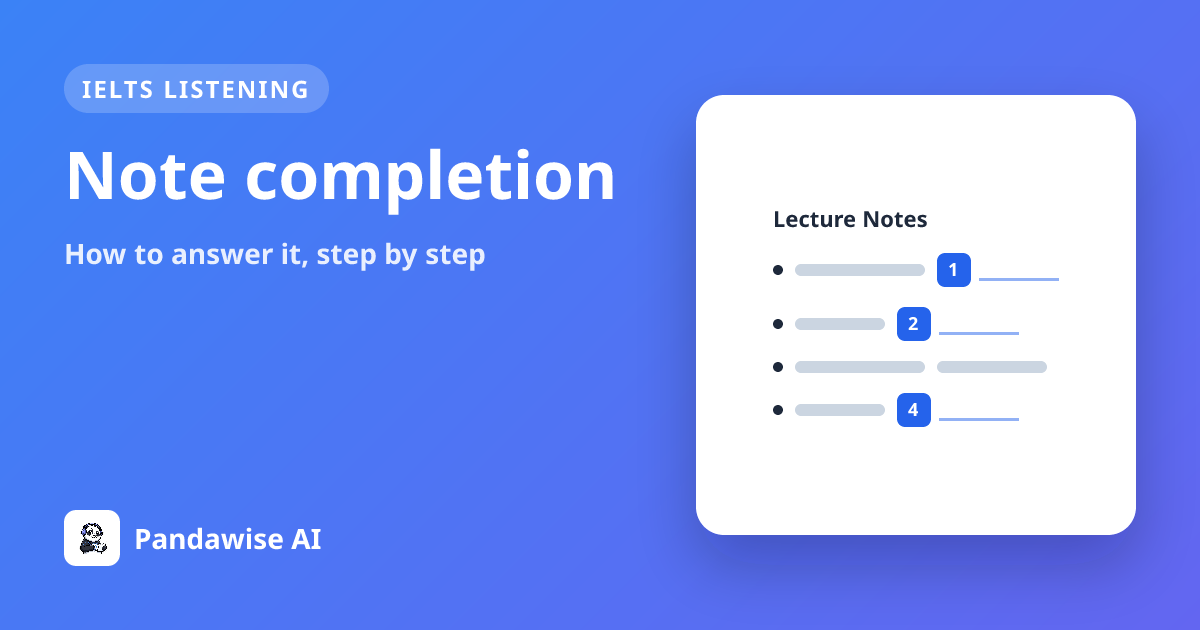
In IELTS Listening note completion tasks, you are given an incomplete set of notes. The notes summarise key information from the recording. Your job is to listen and write the missing words or numbers in the gaps. The notes usually have clear headings and bullet points. The headings are especially helpful in Part 4 because they show you where the speaker is in the lecture. The words around a gap tell you the grammar you need – almost always a noun or noun phrase.
These questions appear in two main places:
- Part 1: The notes are about an everyday situation, such as booking a course or enquiring about a service. The conversation is between two speakers.
- Part 4: The notes are from an academic lecture. There is only one speaker, and the talk does not pause in the middle. The headings guide you through the structure.
Answers must be words you hear in the recording, written exactly as they are spoken. You must stay within the word limit given in the instructions, for example, NO MORE THAN TWO WORDS AND/OR A NUMBER. Spelling counts – a misspelt answer scores zero.
What the Questions Look Like
Every note completion task starts with an instruction line in bold. This tells you the word limit. Here is a typical example:
Write ONE WORD AND/OR A NUMBER for each answer.
Below the instruction, you will see the notes. They often use a table or a list with bullet points. Here is a realistic sample task for a Part 1 enquiry about a library membership:
Notes – Library Membership Enquiry
| Type of membership required: | 1 ________ |
| Full name: | Sarah 2 ________ |
| Postcode: | 3 ________ |
| Main reason for joining: | to use the 4 ________ collection |
| Heard about the library from: | a 5 ________ |
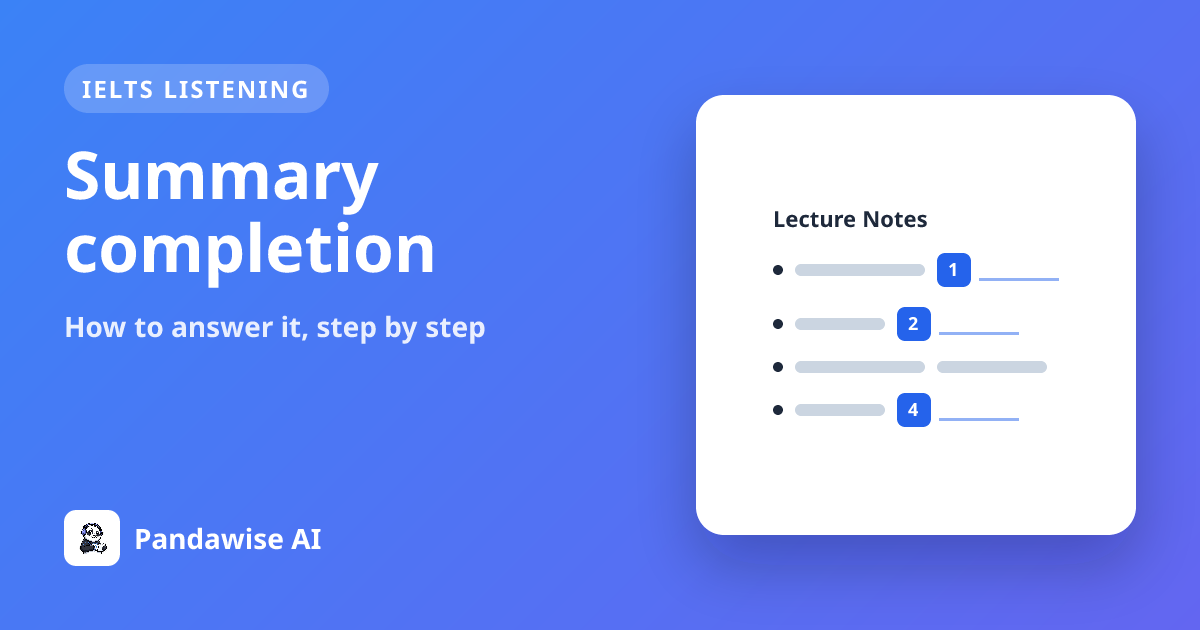
In Part 4, the notes look more like a lecture outline with headings and sub-points. For example:
The History of Glassmaking
- Early origins
- First glass objects: beads, dating from around 1 ________ BC
- Early technique: core-forming, used a 2 ________ as a base
- Roman innovations
- Invention of glassblowing in the 3 ________ century BC
- Allowed production of 4 ________ vessels for the first time
- Spread quickly because of the 5 ________ network
Notice how the headings break the notes into sections. The words before each gap (e.g., "around", "a", "the") signal the grammar and help you predict the answer type.
Step-by-Step Strategy for Note Completion
A clear method will help you stay calm and focused. Follow these steps before, during and after the recording.
Before the Recording
- Read the instructions carefully. Check the word limit. If it says ONE WORD ONLY, a two-word answer is wrong, even if the meaning is correct.
- Study the notes and headings. The headings give you a map of the talk or conversation. In Part 4, they tell you when the speaker moves to a new topic.
- Predict the answers. Look at the words around each gap. What kind of information fits? A date, a name, a place, a noun? Write your guess lightly in pencil if it helps. For example, if you see "a 4 ________", you know the answer is a singular noun.
- Underline key words in the notes that you expect to hear paraphrased. The recording will not use exactly the same words as the notes.
While Listening
- Follow the headings. In Part 4, the speaker does not pause, but the headings in the notes match the structure of the lecture. When the speaker moves to a new heading, move your eyes to that part of the notes.
- Listen for paraphrases. The words in the notes are a summary. The speaker will express the same ideas differently. For example, "main reason for joining" might be heard as "why do you want to become a member?"
- Write exactly what you hear. Do not change the word form. If the speaker says "books", do not write "book". If the speaker says "running", do not write "run".
- Watch out for self-corrections. Speakers often change their mind. "It opens at 9 – sorry, 9.30." The corrected version is the answer.
- Keep moving. If you miss an answer, take a guess and move on. Do not lose your place in the recording.
After the Recording
- Check your spelling. A misspelt word is marked wrong. Common words must be correct.
- Check the word limit. Count the words in each answer. A hyphenated word like "semi-detached" counts as one word.
- Transfer answers carefully if you are taking the paper test. You have 10 minutes for this. On a computer-delivered test, you have 2 minutes to check.
Worked Example with Transcript
Let’s use the library membership notes from earlier. Here is the transcript of the conversation. The receptionist’s speech is labelled, and the customer’s replies are in plain text.
Receptionist: Good morning, how can I help?
I’d like to join the library, please. I need a borrowing membership.
Receptionist: Certainly. We have several types. Is it a standard borrowing membership you’re after, or the premium one with extra online resources?
Just the standard one, thanks.
Receptionist: Right. And your full name?
Sarah Middleton. That’s M-I-D-D-L-E-T-O-N.
Receptionist: Got it. And your postcode?
It’s BN2 4PT.
Receptionist: BN2 4PT. And what’s the main reason you’re joining? Most people come for the DVD collection, but we also have a large fiction section.
Actually, I’m mainly interested in the reference collection. I’m doing some local history research.
Receptionist: That’s a very good section. Finally, how did you hear about us? Was it through the council website?
No, a neighbour told me about it. She said the facilities were excellent.
Now let’s find each answer and explain the traps.
-
Question 1: standard
The customer first says "borrowing membership", but the receptionist clarifies by offering two options: "standard" or "premium". The customer chooses "the standard one". The trap is the first phrase "borrowing membership", which is not the exact type. The correct answer is "standard". -
Question 2: Middleton
The customer clearly spells the surname. The trap is the similar-sounding name "Middleton" – you must spell it exactly as given. The notes already show "Sarah", so only the surname is needed. -
Question 3: BN2 4PT
The postcode is given directly. The receptionist repeats it, which confirms the answer. No trap here, but you must write it with the space and capital letters as spoken. -
Question 4: reference
The notes say "to use the 4 ________ collection". The receptionist mentions "DVD collection" and "fiction section" as common reasons, but the customer corrects this with "Actually, I’m mainly interested in the reference collection." The trap is the two distractors: DVD and fiction. The word "reference" is the corrected answer. -
Question 5: neighbour
The notes say "a 5 ________". The receptionist suggests "council website", but the customer says "No, a neighbour told me". The trap is the website. The answer is the noun "neighbour".
Common Mistakes and Traps
Even strong candidates lose marks on note completion. Here are the most common pitfalls and how to avoid them.
- Writing more words than the limit. If the instruction says ONE WORD ONLY and you write "reference collection", the answer is wrong. Always check the limit before you write.
- Spelling errors. A misspelt answer gets no mark. Common words like "neighbour" or "accommodation" must be correct. Practise spelling frequently used IELTS words.
- Changing the word form. You must write exactly what the speaker says. If the speaker says "collections" (plural), do not write "collection".
- Getting stuck on a missed answer. If you miss one gap, you might lose your place and miss the next two. Guess quickly and move on.
- Ignoring the headings in Part 4. The speaker does not pause, so the headings are your only signposts. If you lose track, look for the next heading in the notes and listen for that topic.
- Falling for distractors. Speakers often mention something, then correct it. The first piece of information is usually a trap. Listen for words like "no", "actually", "sorry", "I mean".
- Writing the answer before hearing the full context. The speaker might say "It costs 15 pounds, but for students it’s 12." If the question is about the student price, the first number is a distractor.
How to Practise Note Completion
Regular, focused practice will improve your skill. Here are some concrete exercises you can do.
- Predict answers from notes alone. Take any set of notes (from practice materials or even your own summaries of short talks) and cover the answers. For each gap, write down what type of word you expect – a number, a date, a noun, a name. Then listen and check if you were right.
- Transcribe short sections. Find a Part 4 lecture recording. Listen to one minute and write down every word. This sharpens your ability to catch exact words and spelling.
- Practise with distractors. Create your own short dialogues where the speaker corrects themselves. For example: "I’ll take the 8 o’clock train – no, the 8.30." Then test yourself on what the final answer is.
- Use headings as a guide. Listen to a Part 4 lecture and pause after each main idea. Write a one- or two-word heading that summarises it. Compare your headings with the notes in a practice test to see how well they match.
- Work on spelling. Make a list of words you often misspell. Practise writing them from dictation. Pay attention to common IELTS topics like education, environment and health.
For structured practice with instant feedback, try the IELTS Listening lessons on Pandawise. You can work through note completion tasks at your own pace and see exactly where you need to improve.
You may also find these related guides helpful:
- all IELTS Listening question types: an overview of the test and of each type, with how to approach it
- IELTS Listening form completion questions
- IELTS Listening sentence completion questions
Key Takeaways
- Note completion questions test your ability to listen for specific details and write them accurately.
- The headings and bullet points show you the structure; use them to follow the recording.
- Always check the word limit and write exactly what the speaker says.
- Watch out for self-corrections and distractors – the first answer is often a trap.
- Spelling must be perfect; a misspelt word scores zero.
- Practise predicting answers, transcribing and spelling to build confidence.
Practise note completion questions
Exam-style lessons and practice tests with real audio, instant marking and an explanation for every answer.
Explore the appFrequently asked questions
What is the difference between note completion and form completion in IELTS Listening?
Note completion tasks use headings and bullet points to summarise information from a talk or conversation, often in Part 4. Form completion tasks are usually in Part 1 and look like an application or booking form with labelled fields such as Name, Address and Phone Number. Both require you to write words you hear, but the layout and context differ.
How can I improve my score in IELTS Listening note completion?
Focus on three areas: prediction, listening for paraphrases and accurate spelling. Before the recording, study the notes and predict the type of word needed. While listening, follow the headings and expect the speaker to use different words from the notes. After the test, check your spelling carefully, as even small errors lose marks.
Are answers in note completion always in the same order as the recording?
Yes, answers to a set of note completion questions almost always come in the same order as the recording. This means you can follow the notes from top to bottom as you listen. If you miss an answer, move to the next gap quickly to avoid losing your place.
What should I do if I miss an answer in the IELTS Listening test?
If you miss an answer, do not panic. Make a quick guess and move on. Keep your eyes on the next gap and listen for the next piece of information. You cannot replay the recording, so staying focused on the present moment is essential. You can always return to the missed question during the transfer time.
Do I lose marks for spelling mistakes in IELTS Listening note completion?
Yes, spelling must be exactly correct. A misspelt answer is marked wrong, even if the examiner can understand what you meant. This applies to both common words and proper nouns. Practise spelling frequently used words and pay attention to how names and places are spelled in the recording.