Question Types
IELTS Listening Sentence Completion: Tips, Strategy & Practice
Learn how to answer IELTS Listening sentence completion questions with a clear step-by-step strategy, a worked example with a distractor, and essential tips to avoid common mistakes.
Pandawise AI · Updated · 10 min read
In this guide
- 1What Are IELTS Listening Sentence Completion Questions?
- 2What the Questions Look Like
- 3Step-by-Step Strategy for Sentence Completion
- 4Worked Example with Transcript and Explanations
- 5Common Mistakes and Traps
- 6How to Practise Sentence Completion Questions
- 7Related IELTS Listening Question Types
- 8Key Takeaways
IELTS Listening sentence completion questions appear in Parts 3 and 4 of the test, where you must fill gaps in sentences that summarise key points from a conversation or lecture. These questions test your ability to listen for specific details and understand paraphrases, because the words on the question paper rarely match the recording exactly. In this guide, you will learn exactly what these questions involve, see a realistic sample task, follow a proven step-by-step strategy, and work through a full example with a distractor. You will also find common mistakes to avoid and practical ways to improve your skills.
What Are IELTS Listening Sentence Completion Questions?
Sentence completion questions are a common task type in the IELTS Listening test. You see a set of sentences with gaps, and you must fill each gap with a word or number from the recording. The sentences summarise information from the audio, but they use different wording—this is paraphrasing. Your answer must fit grammatically into the sentence and stay within the word limit given in the instructions.
These questions usually appear in Part 3 and Part 4. Part 3 is a conversation between two to four speakers in an educational setting, such as students discussing a project with a tutor. Part 4 is an academic lecture by one speaker, with no pause in the middle. In both parts, the sentences condense the main ideas or supporting details. Because the audio is played only once, you need a clear strategy to follow the information and write the correct answer.
What the Questions Look Like
Every sentence completion task begins with an instruction line in bold that tells you the word limit. For example:
Write ONE WORD AND/OR A NUMBER for each answer.
Below this, you see the incomplete sentences. The gaps are numbered, and the sentences appear in the same order as the information in the recording. Here is a realistic sample task based on a Part 3 discussion between two students and a tutor about a research project on urban green spaces.
Questions 1–5
Complete the sentences below.
Write ONE WORD AND/OR A NUMBER for each answer.
| Sentence |
|---|
| The students plan to survey visitors at three different 1 ________. |
| The tutor suggests using a 2 ________ to record responses more efficiently. |
| One student is concerned that the sample size of 3 ________ people may be too small. |
| The final report must include a section on 4 ________ considerations. |
| The deadline for submitting the draft is the 5 ________ of April. |
Notice how each sentence is a complete thought with one missing piece. The words before and after the gap give you clues about what to listen for. For example, in question 1, the gap follows "three different," so you expect a plural noun. In question 5, "the ________ of April" suggests a date or a specific day.
Step-by-Step Strategy for Sentence Completion
A clear strategy helps you use the preparation time well, focus during the recording, and check your answers afterwards. Follow these steps for every sentence completion task.
1. Before the recording: read and predict
You have about 30 to 45 seconds to read the questions before the audio starts. Use this time wisely.
- Check the word limit. Look at the instruction line. If it says "ONE WORD AND/OR A NUMBER," your answer must be a single word, a number, or a combination like "15 minutes." Writing two words when only one is allowed makes the answer wrong.
- Read all the sentences quickly. Get a sense of the topic and the overall meaning. This helps you follow the recording more easily.
- Predict the missing information. For each gap, decide what type of word is needed: a noun, a verb, an adjective, or a number. Also think about the likely meaning. For question 1 above, "three different "—what could the students survey at? Probably locations like "parks" or "gardens." For question 3, " people" suggests a number. Your predictions may not be exact, but they prime your brain to catch the right word.
- Underline key words around the gap. These are the words that the recording will paraphrase. In question 4, "a section on ________ considerations" might be paraphrased as "a part dealing with ________ issues." Focus on the meaning, not the exact words.
2. While listening: listen for paraphrases and write answers
The recording is played once. Stay calm and follow the order of the questions.
- Keep your eyes on the current question, but be aware of the next one. The answers come in order, but if you miss one, move on quickly. Guessing later is better than missing several answers.
- Listen for paraphrases of the key words you underlined. The speaker will not use the same words as the sentence. For example, "plan to survey" might become "we're going to ask." "Too small" might become "not large enough." Train your ear to recognise the same meaning in different words.
- Write exactly what you hear that fits the gap grammatically. If the gap needs a noun and you hear "frequency," write "frequency." Do not change the form unless the sentence requires it, but the sentence structure on the paper usually guides you to the correct form.
- Watch out for self-corrections. Speakers often say one thing and then change their mind. For example, "Let's meet on the fifth—no, actually, the sixth." The corrected version is the answer. Distractors like this are common in Parts 3 and 4.
- Write answers clearly on the question paper. In the paper-based test, you transfer answers later. In the computer-delivered test, you type directly into the gaps. Use abbreviations if needed, but make sure you can read them later.
3. After the recording: check and transfer
At the end of the Listening test, you have time to finalise your answers.
- Paper-based test: You get 10 minutes to transfer answers to the answer sheet. Use this time to check spelling, grammar, and word limits. A misspelt answer scores zero.
- Computer-delivered test: You have 2 minutes to review your answers. Check that each answer fits grammatically and makes sense in the sentence.
- Read the completed sentence silently. Does it sound right? If the sentence says "The tutor suggested using a ________ to record responses" and you wrote "tablet," check that the article "a" matches. If you wrote "tablets," it would be grammatically incorrect.
- Never leave a blank. There is no penalty for wrong answers, so write something sensible for every gap.
Worked Example with Transcript and Explanations
Let's use the sample task from earlier. Below is the transcript of the relevant part of the recording. The conversation is between two students, Maria and David, and their tutor, Dr Evans.
Dr Evans: So, Maria and David, you're looking at how people use urban green spaces. How will you collect data?
Maria: We plan to visit three different parks—Riverside, Central, and Hilltop—and survey visitors there.
David: Yes, we'll ask them about how often they come and what they do. But writing everything down will take ages.
Dr Evans: Have you thought about using a tablet? You could record responses directly, and it would save time later.
Maria: Good idea. We're aiming for a sample of about 80 people, but I'm worried that might not be enough.
Dr Evans: That is a bit limited. If you can, try to get at least 120. But for now, work with what you have.
David: Right. And for the report structure, the guidelines say we need a section on ethical considerations, which we haven't thought about yet.
Dr Evans: Yes, that's essential. You must explain how you'll protect participants' privacy.
Maria: Okay. And the draft deadline is the 15th of April, isn't it?
Dr Evans: Actually, I extended it to the 18th. I sent an email yesterday.
Now let's go through each answer.
Question 1: parks
- The sentence says "three different 1 ________." The paraphrase is "visit three different parks" in the transcript. Maria says exactly "three different parks." The word "parks" fits grammatically as a plural noun and is one word. No distractor here.
Question 2: tablet
- The sentence says "using a 2 ________ to record responses." Dr Evans asks, "Have you thought about using a tablet?" The phrase "record responses" paraphrases "record responses directly" from the transcript. "Tablet" is a singular noun, matching "a." No correction occurs.
Question 3: 80
- The sentence says "sample size of 3 ________ people." Maria says, "a sample of about 80 people." This is a direct match for the meaning. However, Dr Evans later suggests "at least 120." This is a distractor: the question asks for the sample size the students were concerned about, which is 80. The number 120 is a suggestion, not the answer. Write "80" as a number; it is allowed under "AND/OR A NUMBER."
Question 4: ethical
- The sentence says "a section on 4 ________ considerations." David says, "we need a section on ethical considerations." The word "ethical" is an adjective describing "considerations." The paraphrase is almost identical here, which sometimes happens, but in the real test, expect more variation. "Ethical" is one word and fits the grammar.
Question 5: 18th
- The sentence says "deadline for submitting the draft is the 5 ________ of April." Maria first says "the 15th of April." Dr Evans corrects her: "Actually, I extended it to the 18th." This is a classic self-correction trap. The corrected version, "18th," is the answer. Write "18th" or "18" (numbers are acceptable). The word "of April" after the gap confirms a date is needed.
Common Mistakes and Traps
Candidates often lose marks on sentence completion questions because of these predictable traps. Knowing them helps you stay alert.
- Writing more words than allowed. If the instruction says "ONE WORD AND/OR A NUMBER" and you write "a tablet," the answer is wrong because "a" is an extra word. Always count your words. Hyphenated words like "well-being" count as one word.
- Spelling errors. A misspelt answer scores zero, even if the meaning is clear. Common mistakes include double letters ("accomodation" instead of "accommodation") or confusing "-ent" and "-ant" ("dependant" vs. "dependent"). Practise spelling frequently used IELTS words.
- Ignoring grammar. The completed sentence must be grammatically correct. If the gap follows "a," you need a singular noun. If it follows "been," you might need a past participle. Read the sentence with your answer to check.
- Falling for distractors. Speakers often mention a number or word that seems correct, then change it. In the example, "15th" was a distractor for "18th." Always listen for corrections and qualifying phrases like "actually," "no," or "I mean."
- Writing the first word you hear. Because of paraphrasing, the exact word you need might come after several synonyms. For instance, "plan to survey" might be expressed as "intend to interview." Wait for the meaning, not the exact words from the question.
- Losing focus between questions. In Part 4, the lecture has no pauses. If you miss an answer, move on. Stressing over one gap can cause you to miss the next two. Keep your eyes moving down the page.
How to Practise Sentence Completion Questions
Regular, focused practice builds the skills you need to handle paraphrasing, distractors, and fast speech. Here are concrete exercises you can do.
- Predict word types with sample tasks. Take any sentence completion task from a reliable source. Cover the transcript and predict the word class and possible meaning for each gap before listening. This trains your brain to listen actively.
- Transcribe short sections. Listen to a 30-second clip from a Part 3 or Part 4 recording. Write down exactly what you hear, then compare with the transcript. This improves your ability to catch precise words and spelling.
- Paraphrase sentences yourself. Take a sentence from a listening script and rewrite it in your own words. For example, "The study involved 200 participants" becomes "200 people took part in the research." This helps you think like the test designers.
- Practise with distractors. Find recordings where speakers correct themselves. Write down both the distractor and the final answer. Discuss why the first option was wrong.
- Use dictation for spelling. Choose 10 words you find hard to spell. Have someone read them aloud, or use a text-to-speech tool, and write them down. Check your spelling carefully.
For structured practice with instant feedback, you can work through sentence completion tasks and other question types on IELTS Listening lessons. The platform helps you get used to the timing and question formats under realistic conditions.
Related IELTS Listening Question Types
Sentence completion is one of several completion tasks in the Listening test. Understanding the differences helps you approach each one correctly. Explore these related guides:
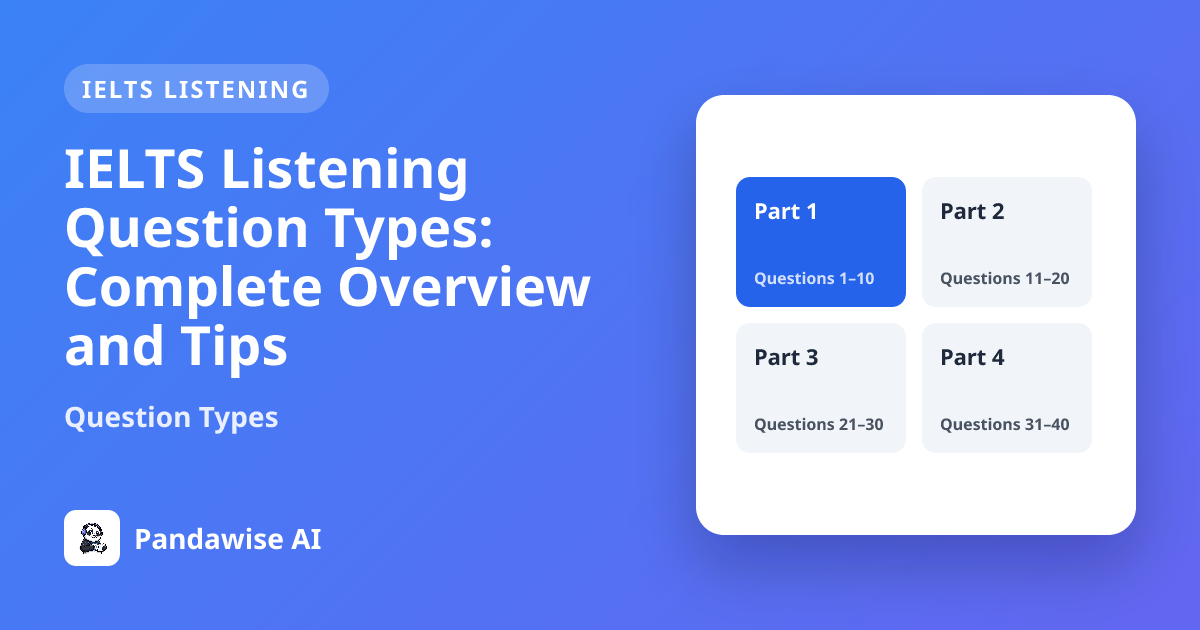
- all IELTS Listening question types: an overview of the test and of each type, with how to approach it
- IELTS Listening form completion questions
- IELTS Listening note completion questions
- IELTS Listening summary completion questions
Key Takeaways
- Sentence completion questions appear in Parts 3 and 4 and require you to fill gaps in paraphrased sentences.
- Always check the word limit and predict the word class and meaning before the recording starts.
- Listen for paraphrases of the key words around the gap, not the exact words from the question paper.
- Watch out for self-corrections and distractors; the speaker's final version is the answer.
- After listening, check that each answer fits grammatically and is spelt correctly.
- Never leave a blank; a guess is always better than no answer.
Practise sentence completion questions
Exam-style lessons and practice tests with real audio, instant marking and an explanation for every answer.
Explore the appFrequently asked questions
What are sentence completion questions in IELTS Listening?
Sentence completion questions are a task type where you read sentences with gaps and fill in each gap with a word or number from the recording. The sentences summarise the audio but use different wording. These questions usually appear in Parts 3 and 4 and test your ability to listen for detail and understand paraphrases.
How do I answer sentence completion questions in IELTS Listening?
First, check the word limit and predict the type of word needed for each gap. Underline key words around the gap and listen for their paraphrases. Write the exact word or number you hear that fits grammatically. Be careful of self-corrections, where the speaker changes an answer. After the recording, check spelling and grammar.
Why is paraphrasing important in sentence completion tasks?
Paraphrasing is important because the words on the question paper rarely match the recording exactly. For example, 'plan to survey' might be said as 'intend to interview.' If you listen only for the exact words, you may miss the answer. Understanding the meaning behind the words helps you catch the correct information.
What are common traps in IELTS Listening sentence completion?
Common traps include writing more words than allowed, misspelling answers, and falling for distractors. Speakers often say one thing and then correct themselves, so the first word you hear may not be the answer. Also, the grammar of the sentence must match your answer, so check that singular or plural forms fit.
How can I improve my score on sentence completion questions?
Practise predicting word types before listening, and work on recognising paraphrases by rewriting sentences in your own words. Do dictation exercises to improve spelling and accuracy. Listen for corrections in recordings and note both the distractor and the final answer. Regular practice with realistic tasks builds confidence and speed.