Task Types
IELTS Discussion Essay: Structure, Model Answer and Common Mistakes
Learn the exact structure for an IELTS discussion essay, study a high-scoring model answer and understand the common mistakes that lower your band score.
Pandawise AI · Updated · 9 min read
In this guide
- 1What the IELTS Discussion Essay Task Requires
- 2A Sample IELTS Discussion Essay Question
- 3How to Plan and Structure an IELTS Discussion Essay
- 4Useful Language for an IELTS Discussion Essay
- 5High-Scoring Model Answer for the Sample Question
- 6Why This Model Answer Works
- 7Common Mistakes That Lower the Band
- 8How to Practise and Key Takeaways
Candidates often find the IELTS discussion essay one of the most demanding question types in Writing Task 2. The prompt asks you to discuss both views and give your own opinion, which means your essay must do three things clearly: present one side of an argument, present the other side, and then make your own position unmistakably clear. Missing any of these elements will lower your Task Response score. This guide gives you a reliable structure, a full model answer and practical advice to avoid the errors that examiners see repeatedly.
What the IELTS Discussion Essay Task Requires
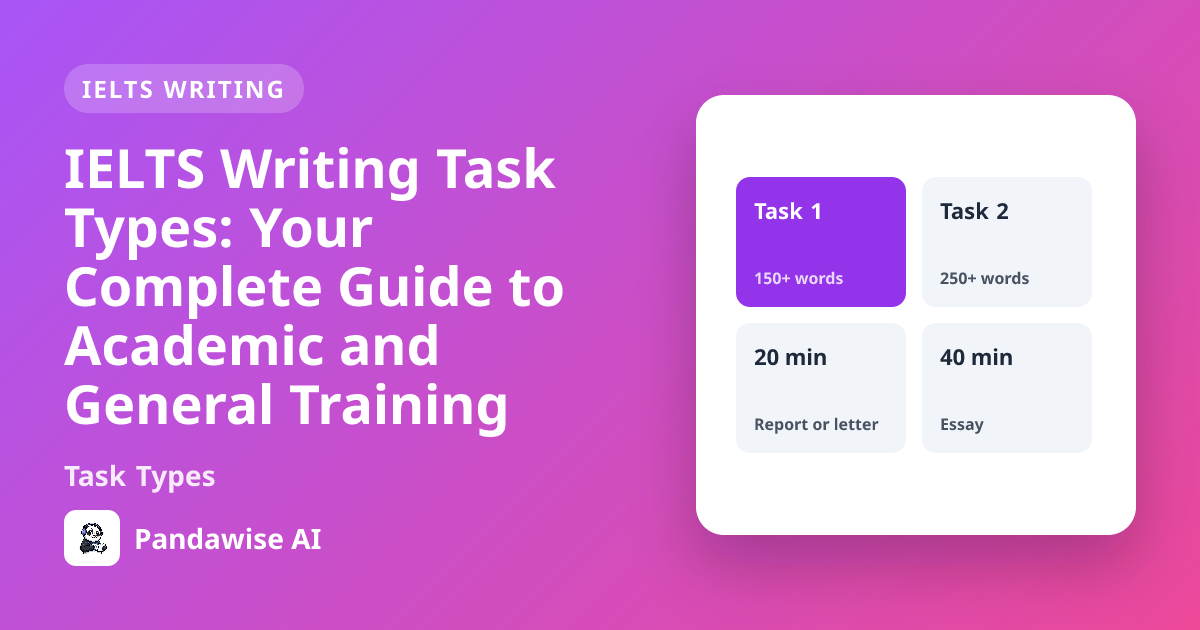
This task appears in IELTS Writing Task 2 for both the Academic and General Training modules. You have 60 minutes for the whole Writing test. Task 2 is worth twice as many marks as Task 1, so you should spend about 40 minutes on it and write at least 250 words. Writing fewer than 250 words will lose you marks.
The instruction on the question paper reads Discuss both these views and give your own opinion. or a very similar wording. The examiner is looking for a balanced discussion of the two views given in the prompt, followed by a clearly stated personal opinion. The opinion must be your own, not a repetition of one of the views. It can agree with one side, disagree with both, or offer a middle position, but it must be explicit.
A common reason for a low Task Response band is that the candidate either forgets to include their own opinion at all, or buries it so vaguely that the examiner cannot identify it. Your opinion should appear in the introduction and be reinforced in the conclusion. Some high-scoring essays also dedicate a separate body paragraph to the opinion, but this is not mandatory as long as the position is clear throughout.
A Sample IELTS Discussion Essay Question
Here is a realistic question of the type you will see on test day.
Some people believe that unpaid community service should be a compulsory part of high school programmes, for example working for a charity, improving the neighbourhood or teaching sports to younger children. Others argue that such activities should be entirely voluntary.
Discuss both these views and give your own opinion.
This is a typical IELTS discussion essay topic: a social issue with two identifiable, opposing perspectives. Your job is to explain why some people hold each view and then state what you think.
How to Plan and Structure an IELTS Discussion Essay
Before you write, spend up to five minutes planning. Read the question twice, underline the two views and the instruction words. Decide on your own opinion immediately—you cannot write a coherent essay if you are still making up your mind halfway through. Then note down two or three ideas for each view and one or two reasons for your own opinion.
A clear, predictable paragraph structure helps Coherence and Cohesion, which is one of the four marking criteria. The table below shows a reliable plan.
| Paragraph | Purpose | What to include |
|---|---|---|
| Introduction | Introduce the topic and state your opinion | Paraphrase the question; briefly mention both views; end with a sentence that makes your own opinion clear. |
| Body paragraph 1 | Discuss the first view | Topic sentence stating the view; two or three supporting points with explanations or examples; a concluding sentence that links back to the question. |
| Body paragraph 2 | Discuss the second view | Topic sentence stating the opposing view; two or three supporting points; a concluding sentence. |
| Body paragraph 3 (optional) | Explain and justify your own opinion | Only if your opinion is complex or differs from both views. Otherwise, weave it into the introduction and conclusion. |
| Conclusion | Summarise the discussion and restate your opinion | Paraphrase the two views briefly; restate your opinion in different words; do not introduce new ideas. |
This structure works because it guarantees you cover both views in equal depth and that your opinion appears at least twice. The optional third body paragraph is useful when your opinion is a compromise or a completely different perspective, but for most questions a well-written introduction and conclusion are enough.
Useful Language for an IELTS Discussion Essay
Examiners reward natural, accurate language, not memorised templates. The phrases below are starting points; adapt them to your own sentence structures.
Introducing the discussion
- It is often argued that…
- Some people take the view that…, while others believe…
- There are those who contend that…, whereas their opponents maintain that…
Presenting the first view
- On the one hand, proponents of this idea point to…
- Those who support compulsory community service often highlight…
- A strong argument in favour of this position is that…
Presenting the second view
- On the other hand, opponents argue that…
- Conversely, many people feel strongly that…
- The case for voluntary participation rests on the belief that…
Giving your own opinion
- My own view is that…
- I firmly believe that…
- While both sides have merit, I am convinced that…
- Having considered both perspectives, I would argue that…
Concluding
- To sum up, although there are valid points on both sides, I believe…
- In summary, while some people are right to say…, it seems to me that…
The key is to use these structures flexibly. Do not force every essay into the same set of phrases.
High-Scoring Model Answer for the Sample Question
Below is a model answer that follows the structure above. It is written in natural British English and stays within the recommended word range.
The role of community service in secondary education is a topic of considerable debate. Some educationalists argue that unpaid work for charities or local projects should be a mandatory element of the high school curriculum, while others maintain that such activities must remain entirely a matter of personal choice. In my opinion, although compulsory schemes have some practical advantages, making community service a requirement undermines its fundamental purpose and I therefore believe it should stay voluntary.
On the one hand, those who favour compulsory community service point to several significant benefits. Firstly, it exposes all young people, regardless of their background, to the needs of their local area and teaches them social responsibility. For example, a teenager who is required to help at a food bank may develop a lasting awareness of poverty and inequality. Secondly, such programmes can provide practical skills—teamwork, communication and problem-solving—that complement academic study. A student coaching younger children in sport learns leadership and patience in a way that classroom lessons cannot replicate. Finally, from a societal perspective, a large, organised workforce of young volunteers could deliver meaningful support to underfunded community projects.
On the other hand, opponents of compulsion make a compelling case. They argue that the essence of volunteering is the freely given desire to help others; once an activity becomes obligatory, it ceases to be genuine service and becomes merely another chore. This can breed resentment rather than altruism. Moreover, a one-size-fits-all programme may ignore the diverse circumstances of students. A young person with caring responsibilities at home, or one who needs paid part-time work to support their family, would find a mandatory placement an unfair additional burden. There is also the practical objection that schools already struggle to deliver core academic content and adding a compulsory non-academic requirement could dilute educational standards.
My own view aligns more closely with the second perspective. While I recognise the potential benefits of exposing all students to community work, I believe that the spirit of volunteering is too important to be sacrificed. Voluntary schemes, well promoted and properly resourced, can attract motivated participants and achieve the same positive outcomes without the drawbacks of coercion. Schools should certainly encourage and facilitate community service, but the final decision must rest with the individual student.
In summary, although making community service compulsory might ensure wider participation and teach useful skills, the loss of genuine volunteer spirit and the practical difficulties it would create are more significant. I am convinced that keeping such activities voluntary is the wiser course.
Word count: 318
Why This Model Answer Works
Task Response
The essay fully addresses all parts of the prompt. Both views are discussed in dedicated body paragraphs with clear supporting points and examples. The writer’s own opinion is stated unambiguously in the introduction, reinforced in a separate paragraph and restated in the conclusion. No part of the question is neglected.
Coherence and Cohesion
The essay follows a logical progression: introduction, first view, second view, own opinion, conclusion. Paragraphs are clearly separated and each begins with a clear topic sentence. Cohesive devices like on the one hand, on the other hand, firstly, moreover and in summary are used appropriately but not overused. Ideas within paragraphs are linked smoothly.
Lexical Resource
The vocabulary is precise and varied without being forced. Phrases like compulsory schemes, social responsibility, altruism, one-size-fits-all programme, and dilute educational standards show a good range. Collocations such as freely given desire, meaningful support and practical objections are natural. There is no repetition of simple words from the prompt.
Grammatical Range and Accuracy
The essay uses a mix of simple, compound and complex sentences accurately. Conditional structures (once an activity becomes obligatory), relative clauses (a teenager who is required), and passive forms (can be sacrificed) appear naturally. There are no systematic errors, and punctuation is correct throughout.
Common Mistakes That Lower the Band
- Missing or unclear opinion. This is the most frequent error. If the examiner cannot find a clear statement of your own view, Task Response is capped at Band 5. State your opinion in the introduction and again in the conclusion at minimum.
- Giving equal space to both views but no opinion paragraph. A balanced discussion is good, but it is not enough. The question explicitly asks for your opinion, so you must provide it.
- Writing a one-sided essay. Some candidates treat the question as an opinion essay and argue only for their own view, ignoring the other side entirely. This fails to meet the “discuss both views” requirement.
- Listing points without development. Each view needs explanation and support. A body paragraph that simply states two ideas without examples or reasoning will not score well for Task Response or Coherence and Cohesion.
- Using memorised templates rigidly. Examiners are trained to spot formulaic language. If every essay begins with “In this modern era…” and ends with “In a nutshell…”, your Lexical Resource score will suffer.
- Neglecting the conclusion. A weak or missing conclusion leaves the essay feeling unfinished and can lower Coherence and Cohesion. Always include a short summary that restates your opinion.
- Writing too few words. An essay under 250 words is penalised. Aim for 270–300 words to give yourself enough space to develop both views and your opinion adequately.
How to Practise and Key Takeaways
Regular, focused practice with expert feedback is the most effective way to improve. You can practise IELTS discussion essay questions and receive detailed corrections on all four marking criteria on the IELTS Writing lessons platform.
- Always identify the two views in the prompt and decide your own opinion before you start writing.
- Use a clear paragraph structure: introduction, first view, second view, (optional opinion paragraph), conclusion.
- Make your opinion explicit in both the introduction and the conclusion.
- Support each view with reasons and examples, not just assertions.
- Practise writing under timed conditions—40 minutes for planning, writing and checking.
- Review your essays against the four criteria, or have them assessed, to spot recurring weaknesses.
Write it and get feedback on every criterion
Exam-style writing tasks marked by an AI examiner on all four criteria, with a band for each.
Explore the appFrequently asked questions
What is an IELTS discussion essay?
An IELTS discussion essay is a Task 2 question that asks you to discuss two opposing views on a topic and then give your own opinion. It appears in both Academic and General Training modules. You must write at least 250 words in about 40 minutes and clearly cover both perspectives before stating your position.
Do I need a separate paragraph for my opinion in a discussion essay?
Not necessarily. Your opinion must be clear in the introduction and conclusion at minimum. However, if your view is nuanced or differs from both given views, a separate body paragraph can strengthen your essay. The key is that the examiner can easily identify your position.
How is an IELTS discussion essay different from an opinion essay?
An opinion essay asks whether you agree or disagree with a single statement. A discussion essay gives two contrasting views and requires you to explore both before giving your own opinion. Missing either view in a discussion essay will lower your Task Response score significantly.
Can I agree with both views in an IELTS discussion essay?
Yes, you can take a balanced position. You might argue that both views have merit under different circumstances, or propose a compromise. The important thing is to state your own opinion clearly, not simply repeat that both sides are valid.
What happens if I forget to give my opinion in a discussion essay?
Task Response is one of the four marking criteria, and it assesses how fully you address the prompt. If you omit your opinion entirely, your Task Response score will be limited to Band 5 or lower, which will significantly affect your overall Writing band score.