Task Types
IELTS Writing Task Types: Your Complete Guide to Academic and General Training
A clear breakdown of every IELTS Writing task type—Academic Task 1 reports, General Training letters and Task 2 essays—with how to structure your answer and avoid common mistakes.
Pandawise AI · Updated · 9 min read
In this guide
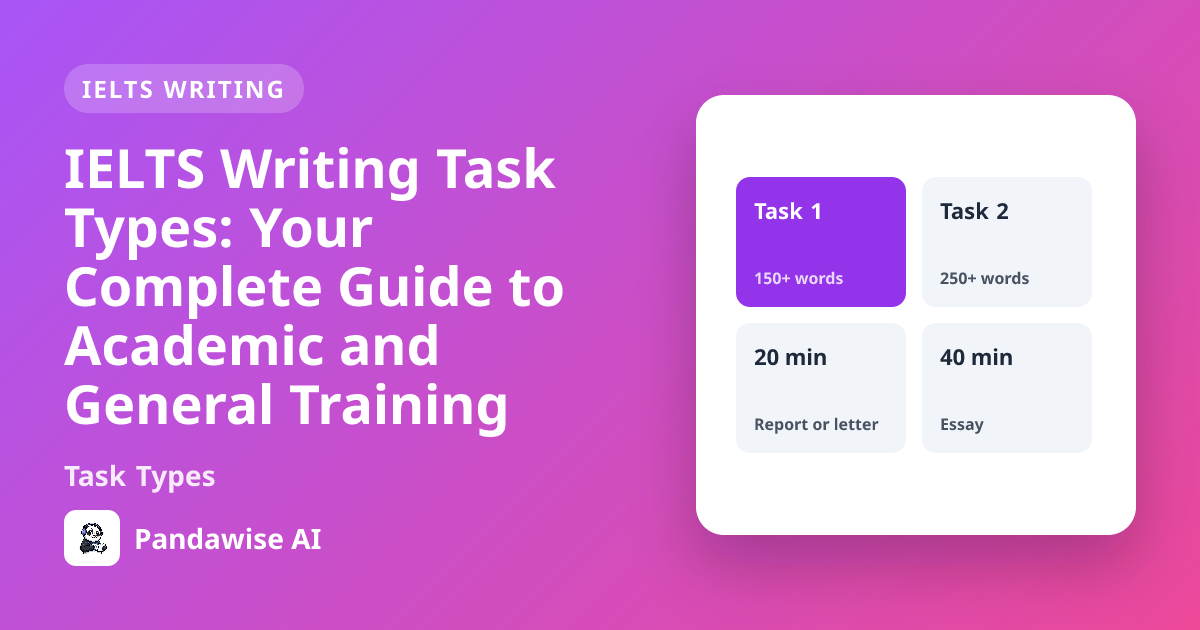
Understanding the different IELTS Writing task types is the first step towards a confident exam performance. Whether you take the Academic or General Training module, the Writing test always has two tasks and lasts 60 minutes. Task 1 asks you to write at least 150 words in about 20 minutes, while Task 2 requires at least 250 words in about 40 minutes. Task 2 contributes twice as much to your final Writing band score as Task 1, so time management matters. This guide walks you through every IELTS Writing task types you will face, from Academic Task 1 visuals and General Training letters to the essay formats that appear in Task 2 for both modules. You will learn what each task demands, how to approach it and which common errors to avoid.
The IELTS Writing test at a glance
Before we explore each IELTS Writing task types, here is a quick overview of the test format.
| Task | Module | What you write | Minimum words | Suggested time | Weight |
|---|---|---|---|---|---|
| Task 1 | Academic | A factual report on visual data | 150 | 20 minutes | 33% |
| Task 1 | General Training | A letter responding to a situation | 150 | 20 minutes | 33% |
| Task 2 | Both | An essay on a given topic | 250 | 40 minutes | 66% |
Answers that fall below the minimum word count are penalised. Examiners count every word, so aim for 160–180 words in Task 1 and 260–280 words in Task 2 to stay safe without writing too much.
Academic Task 1 types
Academic Task 1 always asks you to write a report describing visual information. The data is factual, so you must not include personal opinions or speculate about reasons that are not shown. An overview paragraph that summarises the main trends, stages or features is essential; without one, your Task Achievement score is limited to Band 5 or below. Below are the main IELTS Writing Task 1 types for the Academic module.
Line graphs
Line graphs show changes over time. You need to identify the overall trend (upward, downward, fluctuating) and compare key points such as peaks, lows and intersections. Group similar lines together rather than describing every line separately. For a full step-by-step guide, see IELTS Academic Writing Task 1 line graphs.
Bar charts
Bar charts compare quantities across categories. The categories can be static (one point in time) or dynamic (changes over time). Your report should highlight the highest and lowest values, any noticeable patterns and, where relevant, how the data changes across the time period. Learn more at IELTS Academic Writing Task 1 bar charts.
Pie charts
Pie charts show proportions of a whole. Often you get two or three pie charts to compare, for example across different years or countries. Focus on the largest and smallest segments and any significant shifts between charts. The full guide is IELTS Academic Writing Task 1 pie charts.
Tables
Tables present raw numbers, often with many data points. Your job is to select the most important figures—the highest, the lowest, the biggest differences—and present them clearly without listing every cell. Head to IELTS Academic Writing Task 1 tables for a detailed explanation.
Two or more charts (mixed charts)
Sometimes you receive a combination of chart types, for example a pie chart and a bar chart, or a line graph and a table. You must describe the relationship between the visuals, not just describe each one separately. Find out how at IELTS Academic Writing Task 1 with two or more charts (mixed charts).
Process diagrams
A process diagram illustrates how something works or how something is made. You need to describe each stage in sequence using the present simple passive. No overview of trends is needed; instead, summarise the number of stages, the starting point and the end result. See IELTS Academic Writing Task 1 process diagrams.
Maps
Map tasks usually show the same location at two or three different times, often with a proposed future plan. You compare the changes, using language of location and development. Group changes by area or type rather than jumping randomly around the map. The complete guide is IELTS Academic Writing Task 1 maps.
General Training Task 1 letters
In the General Training module, Task 1 is a letter. You are given a situation and three bullet points you must cover. The tone of your letter depends on the recipient and is a key factor in your Task Achievement score.
Informal letters
Informal letters are written to a friend. The tone is warm and conversational. You can use contractions, phrasal verbs and a friendly opening and closing. The bullet points still guide your content, but the language is relaxed. For examples and structure, visit IELTS General Training Writing Task 1 informal letters.
Semi-formal letters
Semi-formal letters are for someone you know but not well, such as a neighbour, a landlord or a colleague. The tone is polite and respectful but not overly distant. Avoid very casual language but do not be as stiff as a formal letter. Learn the balance at IELTS General Training Writing Task 1 semi-formal letters.
Formal letters
Formal letters go to a company, an official or someone you have never met. The tone is impersonal and polite. Use full forms, avoid contractions and follow a clear, logical structure. Common purposes include complaints, requests and job applications. Read the full guide: IELTS General Training Writing Task 1 formal letters (complaint, request, application).
Task 2 essay types
Task 2 is an essay on a given topic. The IELTS Writing Task 2 essay types are identical for Academic and General Training, though General Training topics tend to be slightly more everyday. You must answer the exact question; off-topic or memorised essays are heavily penalised. Each essay type has a different structure, so learning to identify the question type is essential.
Opinion essays (agree or disagree)
You are given a statement and asked to what extent you agree or disagree. A clear position is required, either in the introduction or the conclusion, and the body paragraphs should support your view. Avoid sitting on the fence unless you genuinely have a balanced opinion, and even then, make your overall stance clear. See IELTS Writing Task 2 opinion essays (agree or disagree).
Discussion essays (discuss both views and give your opinion)
You must discuss two opposing views and then give your own opinion. A common structure is to dedicate one body paragraph to each view and then state your opinion in a separate paragraph or weave it throughout. The question often says "Discuss both these views and give your own opinion." Find out more at IELTS Writing Task 2 discussion essays (discuss both views and give your opinion).
Advantages and disadvantages essays
You are asked to discuss the advantages and disadvantages of a trend, development or situation. Sometimes the question adds "Do the advantages outweigh the disadvantages?", which requires a clear opinion. If the question simply asks for advantages and disadvantages, you can present them without taking a side. The full guide is IELTS Writing Task 2 advantages and disadvantages essays.
Problem and solution essays (causes and solutions)
This type asks you to identify problems or causes of an issue and propose solutions. You must cover both parts equally. A typical structure is one body paragraph for problems/causes and one for solutions, with specific examples for each. Learn how at IELTS Writing Task 2 problem and solution essays (causes and solutions).
Two-part (direct) questions
You receive a statement and two direct questions, for example "What are the reasons for this? Is this a positive or negative development?" You must answer both questions fully, usually with one body paragraph per question. The guide is IELTS Writing Task 2 two-part (direct) questions.
The four marking criteria explained simply
Every IELTS Writing task types is marked against four criteria, each worth 25% of your score. Understanding these helps you focus on what really matters.
- Task Achievement (Task 1) / Task Response (Task 2): For Task 1, this means covering all key features, presenting a clear overview and writing at least 150 words. For Task 2, it means answering all parts of the question, developing a clear position and supporting ideas with relevant examples.
- Coherence and Cohesion: Your writing must be logically organised and easy to follow. Paragraphing is essential—each paragraph should have one clear central idea. Use linking words, but do not overuse them; too many connectors like "Furthermore" and "Moreover" in every sentence is a weakness, not a strength.
- Lexical Resource: This is your vocabulary. Examiners look for a range of words used accurately and appropriately. Spelling mistakes count, and repeating the same words limits your score. Use topic-specific vocabulary and avoid informal language in Academic Task 1 and formal essays.
- Grammatical Range and Accuracy: You need a mix of simple and complex sentence structures. Frequent errors hold your score back, but attempting complex structures even with minor errors is better than only writing short, simple sentences perfectly.
Mistakes that cost marks
Avoid these common pitfalls across all IELTS Writing task types.
- Writing fewer than 150 or 250 words. Examiners deduct marks, and short answers rarely develop ideas enough for a high score.
- Skipping the overview in Academic Task 1. Without a clear summary of main trends or features, Task Achievement is capped.
- Memorising whole essays or templates. Examiners are trained to spot scripted writing. Answers that do not directly address the specific question receive low Task Response scores.
- Going off-topic. Even a well-written essay that does not answer the exact question will lose heavily on Task Response.
- Overusing linking words. Starting every sentence with a connector makes your writing mechanical and unnatural.
- Writing in bullet points or notes. Full sentences and proper paragraphs are required.
- Using informal language in Academic Task 1 or formal essays. Contractions, slang and casual expressions lower your Lexical Resource score.
- Spending too long on Task 1. If you use more than 25 minutes on Task 1, you risk not finishing Task 2, which carries double the weight.
How to practise effectively
Improving your writing for all IELTS Writing task types requires focused practice.
- Time yourself strictly: 20 minutes for Task 1, 40 minutes for Task 2. Build the habit of planning for 2–3 minutes before you start writing.
- Analyse sample answers: Look at how high-scoring responses structure their overviews, paragraphs and conclusions. Notice how they vary vocabulary and sentence structure.
- Practise each task type individually: Do not just write essays. Spend time on line graphs, pie charts, formal letters and discussion essays until you are comfortable with every format.
- Count your words: After each practice, check your word count. Aim for 160–180 words in Task 1 and 260–280 in Task 2.
- Review the marking criteria: After writing, check your work against the four criteria. Did you answer the question fully? Is your paragraphing clear? Did you use a range of vocabulary and grammar?
- Get feedback: An experienced teacher can point out patterns in your errors that you might miss. You can find structured practice and feedback on IELTS Writing lessons.
Key takeaways
- The IELTS Writing test has two tasks: Task 1 (150+ words, 20 minutes) and Task 2 (250+ words, 40 minutes). Task 2 counts twice as much.
- Academic Task 1 is a factual report on visual data; an overview paragraph is essential.
- General Training Task 1 is a letter with a specific tone: informal, semi-formal or formal.
- Task 2 essays come in several types: opinion, discussion, advantages/disadvantages, problem/solution and two-part questions. Each needs a different structure.
- Four criteria decide your score: Task Achievement/Response, Coherence and Cohesion, Lexical Resource and Grammatical Range and Accuracy.
- Avoid memorised templates, off-topic writing, short answers and overused linking words.
- Practise each task type under timed conditions and review your work against the official criteria.
Write it and get feedback on every criterion
Exam-style writing tasks marked by an AI examiner on all four criteria, with a band for each.
Explore the appFrequently asked questions
What are the different IELTS Writing task types?
The IELTS Writing test has two tasks. For Academic, Task 1 is a report on visual data like line graphs, bar charts, pie charts, tables, mixed charts, process diagrams or maps. For General Training, Task 1 is a letter, which can be informal, semi-formal or formal. Task 2 is an essay for both modules, with types including opinion, discussion, advantages and disadvantages, problem and solution, and two-part questions.
How much time should I spend on each IELTS Writing task?
You have 60 minutes total. Spend about 20 minutes on Task 1, which requires at least 150 words, and about 40 minutes on Task 2, which requires at least 250 words. Task 2 is worth twice as much as Task 1, so manage your time carefully. Always leave 2–3 minutes at the end of each task to check for errors.
What happens if I write fewer than 150 or 250 words in the IELTS Writing test?
Writing under the minimum word count will lower your Task Achievement or Task Response score. Examiners count every word, and short answers usually lack the detail and development needed for a high band. Aim for 160–180 words in Task 1 and 260–280 words in Task 2 to stay safe without writing too much.
Is the IELTS Writing Task 2 essay the same for Academic and General Training?
Yes, the essay types are the same for both modules. You may face opinion, discussion, advantages and disadvantages, problem and solution, or two-part questions. The main difference is that General Training topics are often slightly more everyday, while Academic topics can be more abstract, but the task format and marking criteria are identical.
Why is an overview important in Academic Task 1?
The overview summarises the main trends, stages or features of the visual data without going into detail. It is a key requirement of Task Achievement. Without a clear overview, your score for that criterion is limited to Band 5 or below, even if the rest of your report is well written.