Task Types
IELTS Advantages and Disadvantages Essay: Structure, Language and Model Answer
Learn how to write a high-scoring IELTS advantages and disadvantages essay. This guide covers question types, planning, structure and a model answer with examiner commentary.
Pandawise AI · Updated · 10 min read
In this guide
- 1What the IELTS Advantages and Disadvantages Essay Task Is
- 2Sample IELTS Advantages and Disadvantages Essay Question
- 3How to Plan and Structure Your Answer
- 4Useful Language for This Task Type
- 5High-Scoring Model Answer to the Sample Question
- 6Why the Model Answer Works
- 7Common Mistakes That Lower the Band
- 8How to Practise and Key Takeaways
The IELTS advantages and disadvantages essay is a common Task 2 question type that appears in both the Academic and General Training modules. Many candidates lose marks because they do not recognise the two different versions of this task. In this guide, you will learn exactly what the examiner expects, how to structure your answer for each version and how to use natural, high-level language. You will also find a full model answer with detailed commentary on why it would score well.
What the IELTS Advantages and Disadvantages Essay Task Is
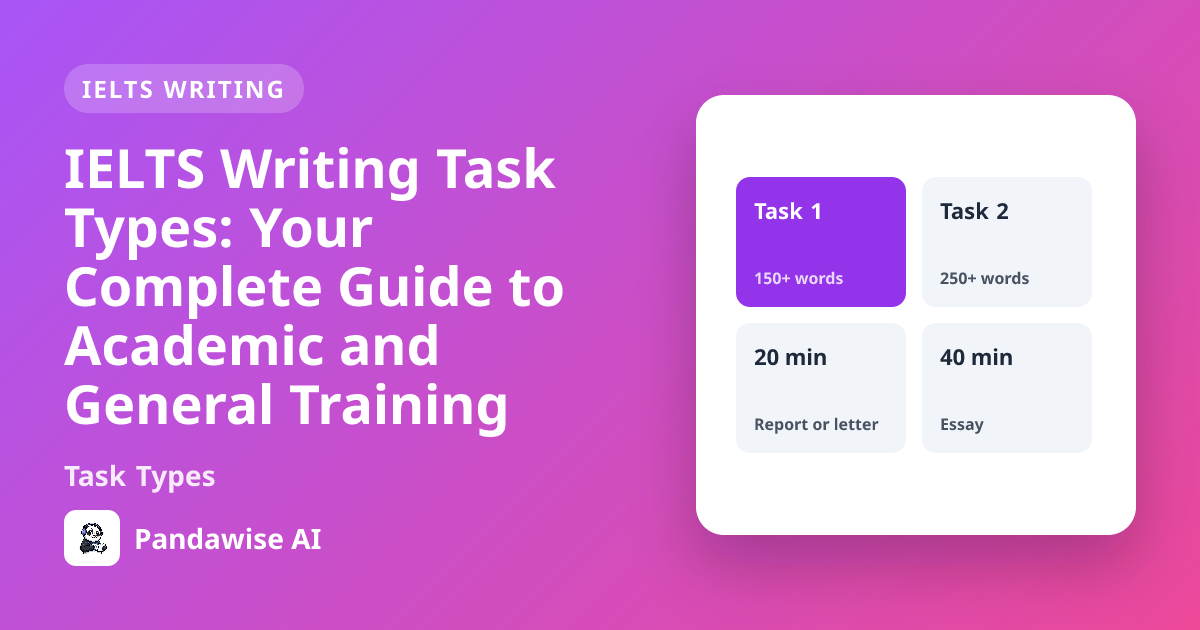
The IELTS advantages and disadvantages essay is a Task 2 question. Task 2 asks you to write an essay of at least 250 words in about 40 minutes. It is worth twice as many marks as Task 1, so it has a big impact on your final Writing band score.
This essay type asks you to consider the positive and negative aspects of a topic. However, there are two distinct versions of the question, and the difference between them is critical.
Version 1: Discuss the Advantages and Disadvantages
In this version, the prompt simply asks you to discuss the advantages and disadvantages of something. You do not need to give your own opinion unless the question explicitly asks for it. Your job is to present both sides in a balanced way.
Example prompt:
In some countries, more and more people are choosing to live alone. What are the advantages and disadvantages of this trend?
Version 2: Do the Advantages Outweigh the Disadvantages?
This version asks you to make a judgement. The phrase do the advantages outweigh the disadvantages means you must decide whether the positives are stronger than the negatives and state this clearly in your essay. The structure is slightly different because you need to show the weighting of your argument.
Example prompt:
Some people believe that it is better for children to grow up in the countryside than in a large city. Do the advantages outweigh the disadvantages?
In both versions, you must read the prompt very carefully. Writing a general discussion when the question asks for a clear opinion on the balance will limit your Task Response score.
Sample IELTS Advantages and Disadvantages Essay Question
Here is a realistic Task 2 question of the second type. We will use this for the planning and model answer sections.
In many countries, governments are investing heavily in space exploration programmes. Some people think this is a waste of public money, while others believe it brings important benefits.
Do the advantages of space exploration outweigh the disadvantages?
This is a classic IELTS advantages and disadvantages essay prompt with the do the advantages outweigh the disadvantages wording. You must take a clear position on whether the benefits are greater than the drawbacks.
How to Plan and Structure Your Answer
Before you start writing, spend the first few minutes of your 40-minute Task 2 time on planning. A clear plan helps you stay on topic, organise your ideas logically and avoid repetition.
Step-by-Step Planning
- Analyse the question: Identify the topic (government spending on space exploration) and the task (do the advantages outweigh the disadvantages?).
- Brainstorm ideas: Note down two or three advantages and two or three disadvantages. Think about examples or explanations for each.
- Decide your position: For an outweighs question, you must decide which side is stronger. Your essay will reflect this by giving more weight to the side you favour.
- Outline your paragraphs: Decide what each paragraph will contain.
Here is a paragraph-by-paragraph plan for our sample question, where the position is that the advantages do outweigh the disadvantages.
| Paragraph | Purpose | What to Include |
|---|---|---|
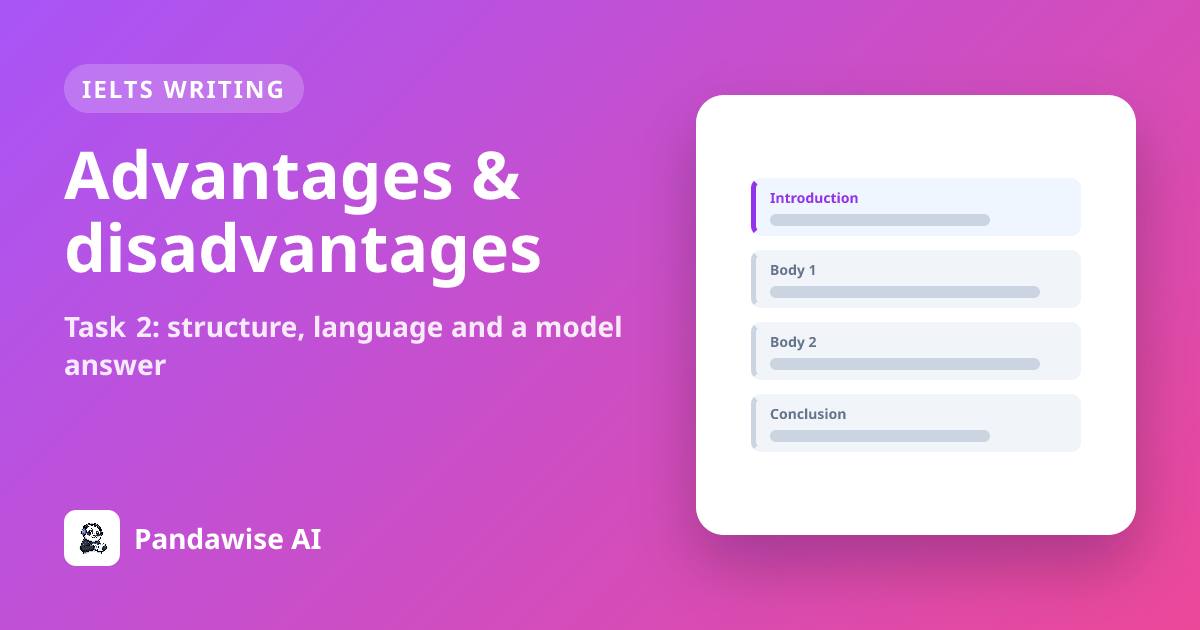
| Introduction | Introduce the topic and state your position | Paraphrase the question; briefly state that while there are financial drawbacks, the long-term benefits are greater. |
| Body Paragraph 1 | Present the disadvantages (the weaker side) | Explain that space programmes are extremely expensive and that this money could be spent on immediate problems like healthcare or education. Use an example. |
| Body Paragraph 2 | Present the advantages (the stronger side) | Explain the key benefits: scientific discovery, technological spin-offs (e.g., satellite technology), and the long-term survival of humanity. Give specific examples. |
| Body Paragraph 3 | Explain why the advantages outweigh the disadvantages | Directly compare the two sides. Argue that the disadvantages are short-term and financial, while the advantages are long-term, global and potentially existential. This paragraph is crucial for the outweighs version. |
| Conclusion | Summarise your position | Restate that despite the high costs, the advantages of space exploration are far more significant for the future. |
Notice that this structure has five paragraphs. The extra body paragraph is where you explicitly explain the weighting. If the question were simply "Discuss the advantages and disadvantages," you would typically write a four-paragraph essay: introduction, one body paragraph for advantages, one for disadvantages and a conclusion that summarises both sides without taking a side.
Useful Language for This Task Type
The language you use should be natural and accurate, not a memorised template. The table below groups useful phrases by function.
| Function | Useful Phrases |
|---|---|
| Introducing advantages | One major benefit of … is …; A significant advantage is that …; … can bring about several positive outcomes; The main argument in favour of … is … |
| Introducing disadvantages | However, there are also drawbacks to consider; A key disadvantage is …; One negative aspect of … is …; Critics argue that … |
| Giving examples | For instance, …; A good example of this is …; This is clearly illustrated by …; … such as … |
| Showing contrast | On the other hand, …; In contrast, …; Nevertheless, …; Despite this, … |
| Expressing degree / outweighing | While there are some disadvantages, the benefits are far greater; The advantages of … clearly outweigh the disadvantages because …; Although … has some negative aspects, these are outweighed by …; The drawbacks are relatively minor compared to the significant gains in … |
| Concluding | In summary, …; Overall, …; To conclude, …; It is clear that the benefits of … are more significant than the potential downsides. |
Avoid overusing simple linking words like "Firstly, Secondly, Finally" in every paragraph. Use a range of cohesive devices naturally, as shown in the model answer.
High-Scoring Model Answer to the Sample Question
Government investment in space exploration is a subject of considerable debate. While there are valid concerns about the financial costs involved, I believe that the long-term benefits of these programmes are far more significant and clearly outweigh the disadvantages.
The primary argument against space exploration is its enormous expense. The funds required to design, build and launch spacecraft run into billions of pounds, and critics argue that this money could be better spent on pressing issues on Earth. For instance, the budget of a single Mars mission could fund several new hospitals or provide clean drinking water to millions of people in developing countries. From this perspective, space programmes can seem like a luxury that diverts resources from immediate human needs.
However, the advantages of space exploration are profound and far-reaching. Firstly, scientific research conducted in space has led to countless technological innovations that benefit daily life. Satellite technology, for example, is essential for global communications, weather forecasting and GPS navigation. Secondly, studying other planets helps us understand our own, particularly in terms of climate change and resource management. Finally, and perhaps most importantly, space exploration addresses the long-term survival of humanity. As Earth faces threats from asteroid impacts and environmental degradation, establishing a presence beyond our planet may one day prove essential.
The key reason why the advantages outweigh the disadvantages is the difference in timescale and impact. The financial costs, while large, are a short-term burden on national budgets. In contrast, the knowledge and technological progress gained from space exploration have permanent, global benefits. A single breakthrough in materials science or energy production, developed for a space mission, can repay the initial investment many times over for generations. The existential argument for securing humanity’s future is also a benefit of incalculable value that a purely financial comparison cannot capture.
In summary, although space exploration requires substantial public funding that could be directed elsewhere, its benefits in terms of scientific progress, practical technology and the long-term security of our species are overwhelmingly greater. It is an investment in the future rather than a waste of resources.
Word count: 317
Why the Model Answer Works
Task Response
The essay fully addresses all parts of the question. It clearly states the writer’s position in the introduction, presents the disadvantages, presents the advantages and then dedicates a whole paragraph to explaining why the advantages outweigh the disadvantages. Every idea is supported with specific examples, such as satellite technology and the cost of a Mars mission.
Coherence and Cohesion
The essay is logically organised and easy to follow. The introduction sets up the argument, and each body paragraph has a clear central topic. Cohesive devices are used effectively but not mechanically: "However," "For instance," "Firstly," "In contrast" and "In summary" all guide the reader without becoming repetitive.
Lexical Resource
The vocabulary is precise and natural. There is good use of less common words and phrases such as "profound and far-reaching," "diverts resources," "existential argument" and "incalculable value." The writer paraphrases successfully, avoiding copying the prompt.
Grammatical Range and Accuracy
The essay demonstrates a wide range of sentence structures, including complex sentences with multiple clauses. For example: "As Earth faces threats from asteroid impacts and environmental degradation, establishing a presence beyond our planet may one day prove essential." Grammar and punctuation are accurate throughout.
Common Mistakes That Lower the Band
- Not answering the exact question: Writing a general advantages and disadvantages essay when the prompt asks "Do the advantages outweigh the disadvantages?" Without a clear judgement, your Task Response score will be limited.
- Giving a balanced list without weighting: For an outweighs question, you cannot simply present one paragraph of advantages and one of disadvantages and then stop. You must explain which side is stronger and why.
- Including your opinion when it is not asked: If the question is simply "Discuss the advantages and disadvantages," do not give your personal view unless the prompt explicitly requests it.
- Writing off-topic: Sometimes candidates misunderstand the topic and write about a related but different issue. Always break down the prompt to identify the exact focus.
- Using memorised templates: Examiners are trained to recognise pre-learned language. An essay that begins "In the modern era, there is a heated debate about…" and ends "In a nutshell…" will not score well for Lexical Resource. Your language must be natural and relevant to the specific topic.
- Poor paragraphing: Writing one long paragraph or failing to separate ideas clearly hurts your Coherence and Cohesion score. Each paragraph should have one clear main idea.
How to Practise and Key Takeaways
Regular, focused practice is the most effective way to improve. Write full essays under timed conditions, and then review them against the official band descriptors. Pay particular attention to whether you have fully answered the specific question type. For structured feedback and targeted lessons, you can use IELTS Writing lessons.
- Always identify whether the question is a simple discussion or an outweighs question before you start writing.
- For outweighs essays, your structure must include a clear explanation of why one side is stronger.
- Use specific examples to support each advantage and disadvantage, rather than making general statements.
- Build a range of natural linking phrases for contrast and emphasis, but avoid overusing formulaic words like "firstly" and "secondly."
- Manage your time carefully: spend a few minutes planning, about 30 minutes writing and a few minutes checking for errors.
For more on the different Task 2 question types, see our guides on IELTS Writing Task 2 opinion essays (agree or disagree) and IELTS Writing Task 2 discussion essays (discuss both views and give your opinion). To understand the full range of writing tasks, visit all IELTS Writing task types: Academic Task 1 visuals, General Training letters and Task 2 essays, with how to approach each.
Write it and get feedback on every criterion
Exam-style writing tasks marked by an AI examiner on all four criteria, with a band for each.
Explore the appFrequently asked questions
What is the difference between 'Discuss the advantages and disadvantages' and 'Do the advantages outweigh the disadvantages'?
The first version asks you to present both sides without necessarily giving your opinion. The second version requires a clear judgement on whether the positives are stronger than the negatives. Your essay structure must reflect this by including a paragraph that explains why one side outweighs the other.
How many paragraphs should an IELTS advantages and disadvantages essay have?
For a simple discussion essay, four paragraphs are standard: introduction, advantages, disadvantages and conclusion. For an outweighs essay, five paragraphs are recommended, with the extra body paragraph used to directly compare the two sides and justify why the advantages or disadvantages are more significant.
Do I need to give my opinion in an advantages and disadvantages essay?
Only if the question asks for it. If the prompt is 'Discuss the advantages and disadvantages,' do not give your opinion unless the wording adds 'and give your opinion.' If the prompt asks 'Do the advantages outweigh the disadvantages?', you must give a clear opinion on the balance.
Can I use a template for my IELTS advantages and disadvantages essay?
You should avoid memorised templates. Examiners penalise language that looks pre-learned and does not fit the specific question naturally. Instead, learn flexible phrases and focus on building a logical structure that answers the exact prompt you are given.
How is the IELTS advantages and disadvantages essay scored?
Like all Task 2 essays, it is scored on four criteria, each worth 25%: Task Response (how well you answer the question), Coherence and Cohesion (how logically your ideas are organised), Lexical Resource (your vocabulary range and accuracy) and Grammatical Range and Accuracy.