Task Types
IELTS Opinion Essay: Structure, Language and Model Answer for Task 2
Learn how to write a high-scoring IELTS opinion essay. This guide covers structure, language and a full model answer for 'agree or disagree' questions in Writing Task 2.
Pandawise AI · Updated · 9 min read
In this guide
- 1What an IELTS Opinion Essay Requires
- 2Sample IELTS Opinion Essay Question
- 3How to Plan and Structure Your IELTS Opinion Essay
- 4Useful Language for an IELTS Opinion Essay
- 5Model Answer for the Sample Question
- 6Why This Model Answer Works
- 7Common Mistakes That Lower the Band
- 8How to Practise and Key Takeaways
An IELTS opinion essay is one of the most common question types in Writing Task 2. You are given a statement and asked whether you agree or disagree, often with the phrase to what extent do you agree. This task appears in both the Academic and General Training modules. Your job is to present a clear position and support it with well-developed ideas. In this guide, you will learn exactly what the examiner expects, how to structure your agree or disagree essay IELTS response, useful language to boost your score, and see a full model answer. We will also cover common mistakes and how to practise effectively.
What an IELTS Opinion Essay Requires
In an IELTS opinion essay, the prompt presents a view or statement. The question will typically be:
- To what extent do you agree or disagree?
- Do you agree or disagree?
You must respond with a clear position. This position can be fully agree, fully disagree, or a balanced view (partly agree). A partly agree position is acceptable as long as it is consistent and clear throughout the essay. The examiner is not looking for a particular opinion; they are assessing how well you can express and support your ideas.
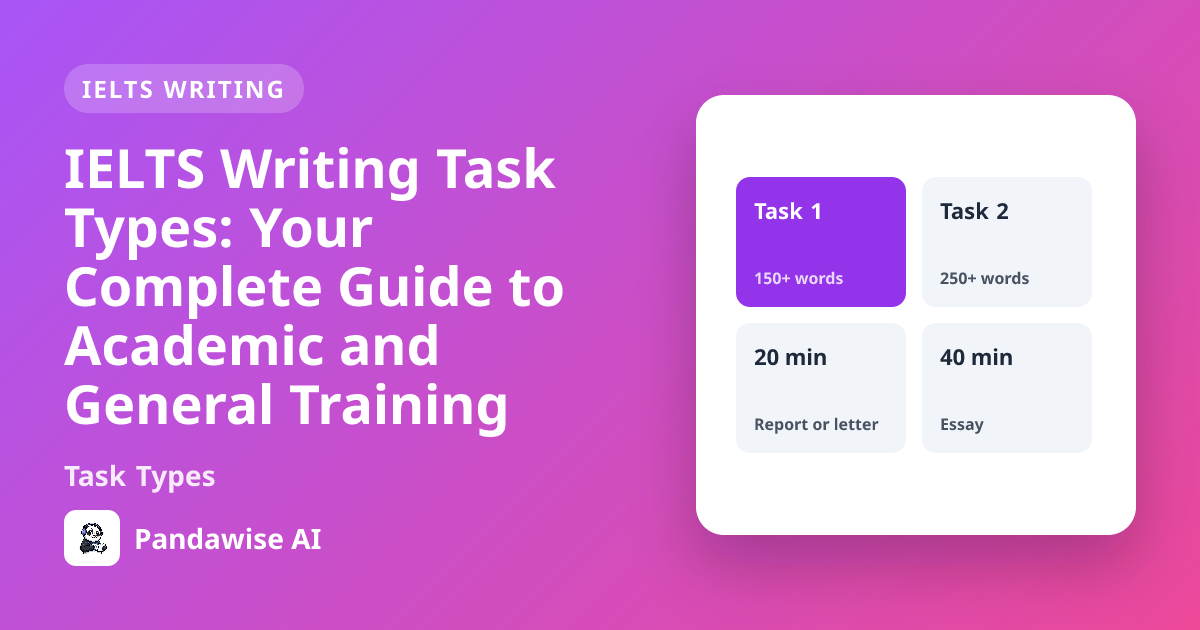
This task is part of Writing Task 2, which is the same for both Academic and General Training. You have 60 minutes for the whole writing test: about 20 minutes for Task 1 and 40 minutes for Task 2. Task 2 is worth twice as many marks as Task 1, so it is essential to perform well here. You must write at least 250 words. Writing fewer than 250 words will reduce your score in Task Response.
The essay is marked against four criteria, each worth 25% of your Task 2 score:
- Task Response: how fully you address the question, present a clear position, and support your ideas.
- Coherence and Cohesion: how logically your essay is organised, including paragraphing and use of linking devices.
- Lexical Resource: the range and accuracy of your vocabulary.
- Grammatical Range and Accuracy: the range and accuracy of your sentence structures.
For an opinion essay, Task Response is critical. You must state your opinion in the introduction and maintain it until the conclusion. If you partly agree, you can discuss both sides, but your own position must remain the focus. Do not simply discuss the other side at length unless your position is partial. Avoid memorised or template-heavy introductions; examiners penalise language that does not fit the specific question.
Sample IELTS Opinion Essay Question
Below is a typical agree or disagree essay IELTS question. Read it carefully and think about what position you would take.
Some people believe that governments should spend money on building new railway lines for very fast trains between cities. Others think that money should be spent on improving existing public transport.
To what extent do you agree or disagree?
This question asks for your opinion on government spending priorities. You could agree that new fast trains are more important, disagree and argue for improving existing transport, or take a balanced view. Whatever you choose, you must explain why.
How to Plan and Structure Your IELTS Opinion Essay
Planning is essential. Spend the first 5 minutes of your 40-minute Task 2 time analysing the question and organising your ideas. A clear plan will help you write a coherent essay and avoid going off-topic.
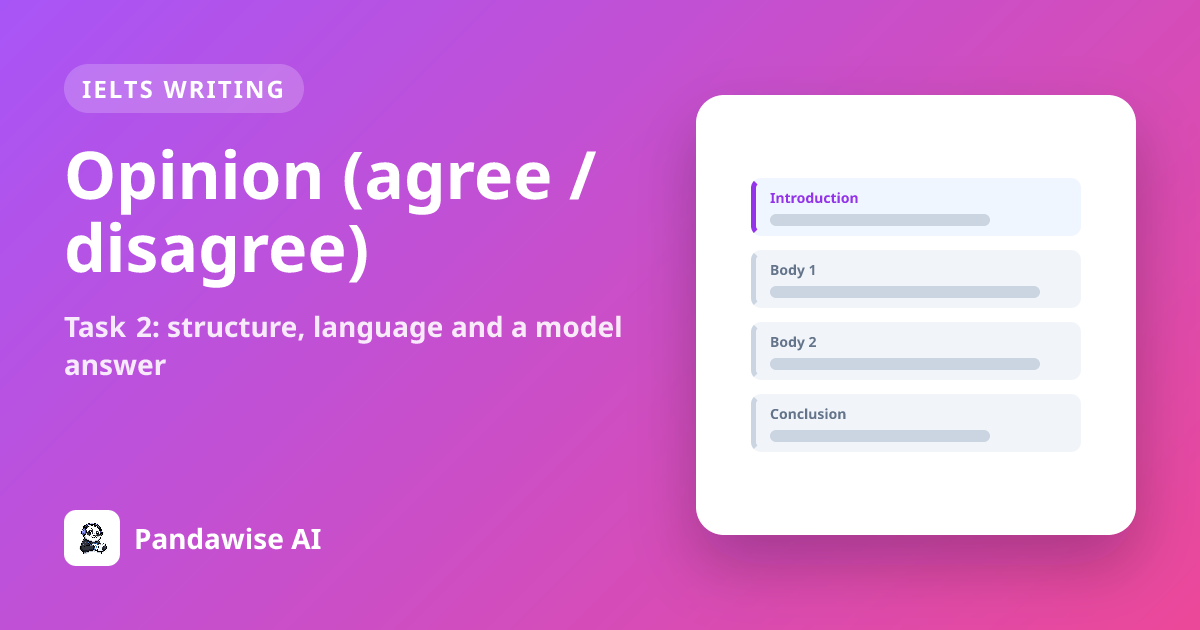
Follow this IELTS Writing Task 2 opinion essay structure:
| Paragraph | Purpose | What to include |
|---|---|---|
| Introduction | Present the topic and your clear position | Paraphrase the question statement; state whether you agree, disagree, or partly agree. |
| Body Paragraph 1 | First main reason for your position | A clear topic sentence; explanation of the idea; a specific example. |
| Body Paragraph 2 | Second main reason for your position | A clear topic sentence; explanation of the idea; a specific example. |
| Body Paragraph 3 (optional) | Third reason, or a concession if you partly agree | If you partly agree, you can acknowledge the other side briefly, then reinforce your main position. |
| Conclusion | Summarise your position | Restate your opinion in different words; do not introduce new ideas. |
Your essay should have two or three body paragraphs. Each body paragraph must contain one main idea, an explanation, and an example. The example can be from your own knowledge or experience; it does not need to be a real-world statistic. The key is that it supports your point clearly.
For a fully agree or fully disagree essay, use two or three paragraphs to give reasons for your view. Do not discuss the opposing view at length. For a partly agree essay, you can structure it like this:
- Body 1: reasons why you agree to some extent.
- Body 2: reasons why you also see the other side, or limitations of your agreement.
- Body 3 (optional): a final reason that reinforces your overall balanced position.
Your conclusion must reflect the position you stated in the introduction. If you partly agree, your conclusion should also be balanced.
Useful Language for an IELTS Opinion Essay
Using a range of natural phrases will improve your Lexical Resource score. Avoid memorising full sentences; instead, learn flexible chunks that you can adapt to any question. Here is a table of useful language for different parts of your essay.
| Function | Useful phrases |
|---|---|
| Stating your opinion | I strongly agree that… / I completely disagree with the view that… / While I agree to some extent, I believe that… / In my opinion, … |
| Introducing a reason | The primary reason for this is… / One significant argument is… / This is mainly because… |
| Explaining an idea | In other words, … / This means that… / As a result, … |
| Giving an example | For instance, … / A clear example of this is… / Take the case of… |
| Conceding a point (for partial agreement) | Admittedly, there is some truth in the argument that… / It is true that… however, … / While I accept that…, I still believe that… |
| Concluding | Overall, I remain convinced that… / In summary, while there are arguments on both sides, I believe that… / To conclude, my view is that… |
Do not overuse linking words like firstly, secondly, moreover, furthermore. A high-scoring essay uses a mix of cohesive devices and relies on logical progression of ideas. Overusing linking words can make your writing seem mechanical and lower your Coherence and Cohesion score.
Model Answer for the Sample Question
Here is a high-scoring model answer to the sample question above. It follows the recommended structure and uses natural language. The position is partly agree.
While I agree that upgrading existing public transport is essential, I believe that investing in new high-speed rail lines can bring significant long-term benefits. This essay will explain why a balanced approach is the most effective.
On the one hand, improving current public transport systems addresses immediate needs. Many urban areas suffer from overcrowded buses and unreliable train services. By allocating funds to increase frequency, expand routes, and modernise vehicles, governments can quickly enhance daily commutes for millions. For example, in my city, a recent investment in electric buses reduced waiting times and air pollution, directly improving residents’ quality of life. Such improvements are cost-effective and deliver fast results.
On the other hand, constructing new railway lines for very fast trains offers transformative economic and environmental advantages. High-speed rail connects cities more efficiently than road or air travel, encouraging business and tourism. It also reduces reliance on cars and planes, cutting carbon emissions. For instance, the introduction of a high-speed line between two major European cities led to a significant shift from short-haul flights to rail, benefiting the environment. These projects may require substantial initial spending, but the long-term gains justify the investment.
However, I do not believe that governments should focus exclusively on one option. A strategy that combines both approaches is likely to be most successful. Upgrading existing transport solves pressing problems, while new high-speed rail builds capacity for future growth. By balancing these priorities, authorities can create a comprehensive and sustainable transport network.
In summary, although improving current public transport is undeniably important, I am convinced that investing in new high-speed rail is equally valuable. A combined strategy addresses both short-term needs and long-term development goals.
Word count: 273
Why This Model Answer Works
Task Response
The essay clearly states a partly agree position in the introduction and maintains it throughout. Each body paragraph presents a distinct reason with explanation and example. The conclusion accurately reflects the balanced view. The question is fully addressed without irrelevant ideas.
Coherence and Cohesion
Paragraphing is logical: introduction, two main body paragraphs, a concession paragraph, and a conclusion. Ideas flow smoothly with appropriate linking phrases like on the one hand, on the other hand, and however. The essay does not overuse mechanical linking words.
Lexical Resource
Vocabulary is precise and varied: upgrading, allocating funds, transformative, carbon emissions, comprehensive. Collocations such as long-term benefits and pressing problems are used naturally. There is no repetition or awkward phrasing.
Grammatical Range and Accuracy
The essay uses a mix of complex and simple sentences accurately. Structures include conditional clauses (by allocating funds…, governments can), relative clauses (that combines both approaches), and passive forms (is likely to be most successful). There are no grammatical errors.
Common Mistakes That Lower the Band
- Not stating a clear position: If your introduction is vague or you change your opinion in the conclusion, your Task Response score will suffer. Decide your view before you start writing.
- Discussing both sides equally when you fully agree or disagree: If you strongly agree, do not write a whole paragraph about the opposing view. This confuses your position. Only do this if you partly agree.
- Writing under 250 words: This directly reduces your Task Response score. Practise writing enough content by developing each idea fully with explanation and example.
- Using memorised templates: Examiners recognise pre-learned phrases that do not fit the question. Focus on flexible language and answering the specific prompt.
- Weak examples: Examples should be specific and support your point. Avoid vague statements like many people think or in many countries. Use a concrete case, even if imagined.
- Poor paragraphing: Writing one long paragraph or many tiny ones hurts Coherence and Cohesion. Use clear paragraphs, each with one central idea.
- Overusing linking words: Starting every sentence with firstly, secondly, moreover makes your essay sound robotic. Use a range of cohesive devices and let your ideas connect logically.
How to Practise and Key Takeaways
To improve your IELTS opinion essay skills, regular focused practice is essential. Work with realistic questions and apply the structure and language from this guide. You can find guided practice and feedback on IELTS Writing lessons.
Key takeaways:
- Always give a clear position in the introduction and keep it consistent.
- Use two or three body paragraphs, each with one main idea, explanation, and example.
- For a partly agree essay, you may briefly discuss the other side, but your own view must dominate.
- Learn flexible phrases for stating opinions, explaining ideas, and giving examples.
- Spend 5 minutes planning before you write to organise your thoughts.
- Check your word count; aim for 270–300 words to be safe.
For more on other Task 2 question types, see our guides on IELTS Writing Task 2 discussion essays and IELTS Writing Task 2 advantages and disadvantages essays. Understanding all IELTS Writing task types will help you feel confident on test day.
Write it and get feedback on every criterion
Exam-style writing tasks marked by an AI examiner on all four criteria, with a band for each.
Explore the appFrequently asked questions
Can I partly agree in an IELTS opinion essay?
Yes, a partly agree position is fine as long as it is clear and consistent. State your balanced view in the introduction, explain both sides in the body, and reflect that balance in the conclusion. Do not sit on the fence; make sure your overall stance is evident.
What is the difference between 'agree or disagree' and 'to what extent do you agree'?
Both prompts require your opinion on a statement. 'To what extent do you agree' invites a more nuanced response, making a partly agree position natural. 'Do you agree or disagree' can also be answered with a balanced view, but a clear yes or no is equally acceptable.
How many paragraphs should an IELTS opinion essay have?
A typical structure is four or five paragraphs: introduction, two or three body paragraphs, and a conclusion. Each body paragraph should develop one main idea with explanation and example. Avoid one-sentence paragraphs or a single huge paragraph.
Do I need to discuss both sides in an agree or disagree essay?
Only if you partly agree. If you fully agree or fully disagree, focus entirely on reasons for your view. Discussing the opposing side at length would weaken your position and confuse the reader about your stance.
How can I improve my vocabulary for IELTS opinion essays?
Learn flexible opinion phrases and topic-specific collocations. Practise paraphrasing common statements and using synonyms. Read model answers to see how vocabulary is used in context. Avoid memorising long templates; examiners reward natural, accurate language.