Task Types
IELTS Two Part Question Essay: Structure, Language and Model Answer
Master the IELTS two part question essay with this step-by-step guide. Get a clear structure, natural language and a full model answer to see exactly what examiners expect.
Pandawise AI · Updated · 9 min read
In this guide
An IELTS two part question essay is a common Task 2 type that asks you to answer two separate direct questions in one essay. Many candidates find this format tricky because you must fully address both questions while keeping your essay cohesive. This guide explains exactly what an IELTS direct question essay requires, how to plan your answer and which language to use. You will also study a high-scoring model answer and learn how to avoid typical mistakes.
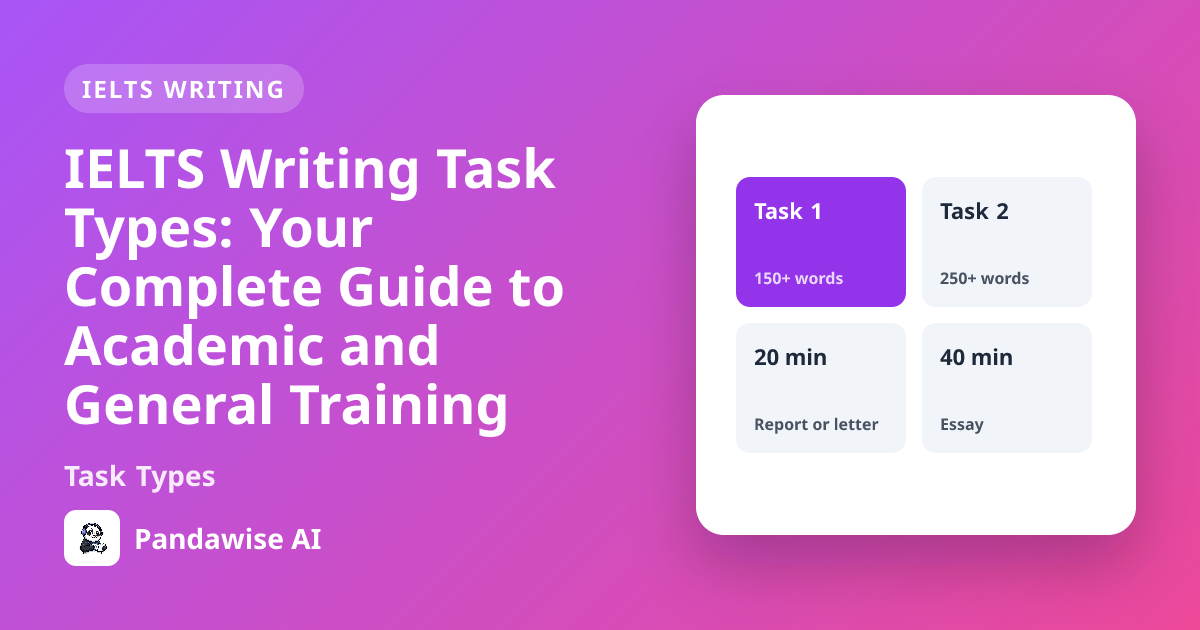
Whether you are taking the Academic or General Training module, Task 2 follows the same format. You have about 40 minutes to write at least 250 words. The essay is worth twice as many marks as Task 1, so a strong performance here makes a real difference. In an IELTS Writing Task 2 two questions prompt, you cannot simply give your opinion on one issue; you must respond to each question directly and equally.
What an IELTS two part question essay is
In Writing Task 2, you receive a statement or a short description of a situation followed by two direct questions. These questions are separate but related to the same topic. The prompt does not ask you to discuss both sides of an argument or to agree or disagree with a single view. Instead, it asks two distinct questions, such as:
- Why is this happening? Is this a positive or negative development?
- What are the causes of this trend? What solutions can you suggest?
- How does this affect individuals? What can governments do about it?
This task type appears in both the Academic and General Training modules. The topics in General Training are slightly more everyday, but the essay structure and marking criteria are identical.
Examiners expect you to answer both questions fully. Each question usually deserves its own body paragraph. Your introduction should briefly answer both questions, and your conclusion should restate those answers. The word count requirement is at least 250 words, and you should spend about 40 minutes on this task. Writing fewer than 250 words will reduce your score.
This task type is sometimes called an IELTS direct question essay because the questions are straightforward and do not ask you to choose a side in a debate. However, you still need to develop your ideas with explanations and examples, just as you would in any other Task 2 essay.
A sample IELTS two part question essay prompt
Here is a typical prompt you might see in the exam:
In many countries, people are living longer than ever before.
Why is this happening?
Is this a positive or negative development?
Notice that the first question asks for reasons, and the second asks for an evaluation. You must answer both. If you only explain why people live longer and forget to say whether it is positive or negative, your Task Response score will be limited.
How to plan and structure your answer
Good planning saves time and improves coherence. Spend the first five minutes analysing the question and organising your ideas. Follow these steps:
- Identify the topic and the two questions. Underline the keywords. In the sample above, the topic is increased life expectancy. Question 1: reasons. Question 2: positive or negative.
- Brainstorm ideas for each question. Write short notes, not full sentences. For question 1, you might think of better healthcare, improved nutrition and safer living conditions. For question 2, you could note both positive aspects (more time with family, continued contribution to society) and negative aspects (strain on pension systems, increased healthcare costs), then decide your overall position.
- Decide your position for question 2. You do not need to give a balanced answer unless the question asks for it. Here, you can say it is mostly positive, mostly negative, or both. Choose the position you can support best.
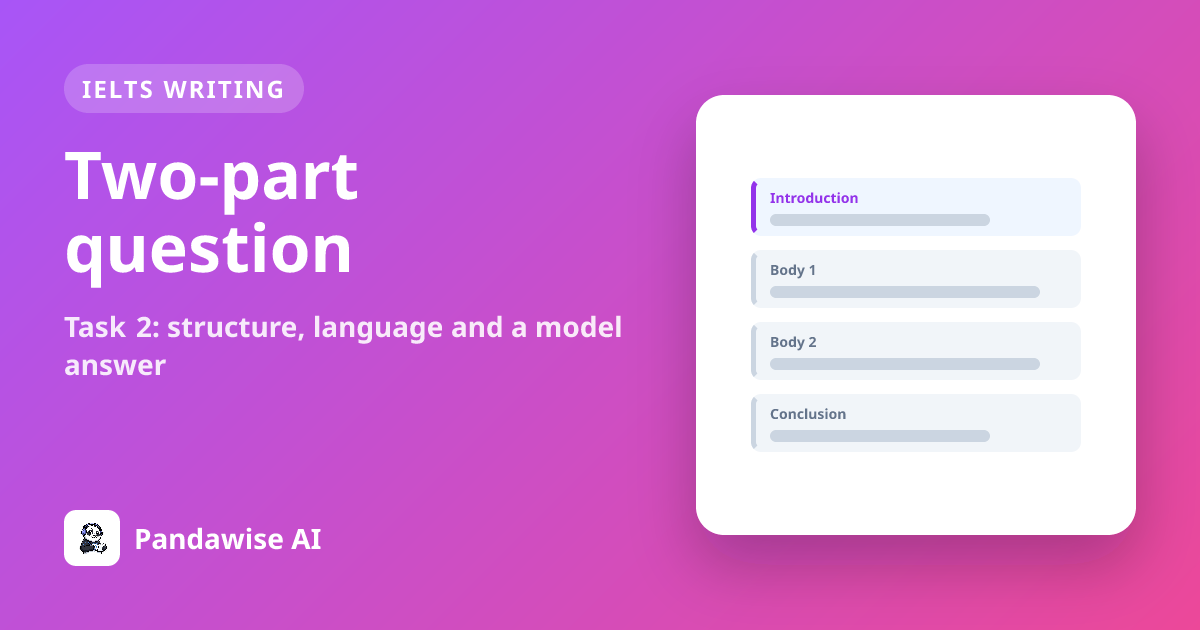
- Plan your paragraphs. A clear structure helps Coherence and Cohesion.
Here is a paragraph-by-paragraph plan for the sample question:
| Paragraph | Purpose | What to include |
|---|---|---|
| Introduction | Present the topic and briefly answer both questions | Paraphrase the statement. State that there are several reasons for longer lives and that, overall, this is a positive development (or your chosen stance). |
| Body paragraph 1 | Answer question 1 fully | Explain two or three reasons why people are living longer, with examples. |
| Body paragraph 2 | Answer question 2 fully | Explain why this is positive or negative, with clear supporting points. If you see both sides, you can mention the opposing view briefly but make your overall position clear. |
| Conclusion | Restate both answers | Summarise the reasons and your evaluation. No new ideas. |
This structure works for any IELTS two part question essay. If the questions are very different, you might need a slightly different balance, but the principle stays the same: one body paragraph per question.
Useful language for an IELTS direct question essay
The language you use should sound natural, not memorised. Examiners penalise essays that rely on obvious templates. However, certain phrases can help you structure your answer clearly.
Introducing the topic
- In recent years, there has been a significant increase in…
- It is true that…
- Nowadays, many countries are experiencing…
Answering the first question (reasons, causes, factors)
- There are several reasons why this is the case.
- One key factor is…
- Another contributing element is…
- This can be attributed to…
Answering the second question (evaluation, effects, solutions)
- In my view, this is largely a positive development because…
- However, there are also some drawbacks to consider.
- From a societal perspective, this trend can be seen as…
- The most significant effect is…
Giving examples
- For instance,…
- A clear example of this is…
- This is particularly evident in…
Concluding
- To sum up, longer life expectancy results from… and I believe this is…
- Overall, while there are some negatives, the benefits outweigh them.
Avoid overusing linking words like firstly, secondly, moreover and furthermore in every sentence. Use them only when they genuinely help the reader follow your argument.
High-scoring model answer
Below is a model answer to the sample question. It follows the plan above and uses natural, accurate English.
In many parts of the world, average life expectancy has risen considerably over the past century. This essay will first explore the main reasons behind this trend and then argue that, despite some challenges, it is a largely positive development.
There are several factors that explain why people are living longer. Firstly, advances in medical science have dramatically reduced deaths from infectious diseases and improved treatment for chronic conditions. Vaccination programmes, for example, have virtually eliminated illnesses that once killed millions. Secondly, better nutrition and greater awareness of healthy lifestyles mean that fewer people suffer from diet-related diseases. In many developed countries, public health campaigns have encouraged people to exercise more and eat balanced diets. Finally, improved living standards, including cleaner water and safer housing, have contributed to longer, healthier lives.
As for whether this is a positive or negative development, I believe the advantages outweigh the disadvantages. On the positive side, individuals can enjoy more years with their families and pursue personal goals well into old age. Many older people also continue to contribute to society through voluntary work or by sharing their expertise. However, an ageing population does place pressure on healthcare systems and pension funds. Governments may need to raise the retirement age or increase taxes to cover these costs. Nevertheless, these problems can be managed with careful planning, and they do not cancel out the clear benefit of longer human lives.
To sum up, longer life expectancy is mainly due to medical progress, healthier lifestyles and better living conditions. While there are economic challenges, I consider this trend to be overwhelmingly positive.
Word count: 267
Why the model answer works
Task Response The essay answers both questions directly and fully. The first body paragraph gives three clear reasons for increased life expectancy. The second body paragraph evaluates the development, acknowledging both sides but stating a clear overall position. The introduction and conclusion reflect both answers. No part of the question is ignored.
Coherence and Cohesion The essay has a logical four-paragraph structure. Ideas flow smoothly within paragraphs, and linking words are used naturally. The first body paragraph uses firstly, secondly and finally to list reasons, but the second paragraph uses more subtle cohesion, such as on the positive side and however. The conclusion clearly signals the end without using a memorised phrase.
Lexical Resource The vocabulary is precise and varied. Phrases like life expectancy, advances in medical science, chronic conditions, public health campaigns and ageing population show a good range of topic-specific lexis. There is also effective use of less common words such as virtually eliminated, contribute to society and overwhelmingly positive.
Grammatical Range and Accuracy The essay uses a mix of simple and complex sentence structures accurately. There are complex sentences with subordinating conjunctions (because, while, although), and the punctuation is correct. There are no basic errors, and the range of structures demonstrates flexibility.
Common mistakes that lower the band
- Not answering both questions equally. Some candidates write a lot about the first question and only a sentence or two about the second. This limits Task Response. Each question deserves roughly equal development.
- Giving an unbalanced answer when not required. If the question asks Is this positive or negative?, you can choose one side. You do not have to give a balanced discussion unless you want to, but you must make your position clear.
- Writing a generic opinion essay. An IELTS direct question essay is not the same as an agree or disagree essay. Do not use a template that only gives your opinion on the topic. You must answer the specific questions asked.
- Ignoring the introduction or conclusion. Some candidates dive straight into the first body paragraph without setting the context. Others forget to restate their answers in the conclusion. Both elements are essential for Coherence and Cohesion.
- Overusing memorised phrases. Sentences like This essay will discuss both sides and give my opinion are irrelevant if the prompt does not ask for a discussion. Use language that fits the exact task.
- Writing too few words. An essay under 250 words loses marks. Practise writing enough to develop your ideas fully.
How to practise and key takeaways
To improve your performance on IELTS Writing Task 2 two questions essays, regular, focused practice is essential. Use real prompts and time yourself strictly. After writing, check whether you have answered both questions clearly and whether your paragraphs are well developed.
You can find guided practice and detailed feedback on IELTS Writing lessons. Working with a variety of question types will build your confidence and flexibility.
Key takeaways
- An IELTS two part question essay asks two direct questions that you must answer fully.
- Plan your essay so that each body paragraph addresses one question.
- Your introduction should briefly answer both questions, and your conclusion should restate those answers.
- Use natural linking language and avoid memorised templates.
- Balance your answer: give roughly equal attention to each question.
- Practise with a timer and review your work against the four marking criteria.
For more on other Task 2 types, see our guides on IELTS Writing Task 2 opinion essays and IELTS Writing Task 2 discussion essays. If you want a complete overview of all IELTS writing tasks, visit all IELTS Writing task types.
Write it and get feedback on every criterion
Exam-style writing tasks marked by an AI examiner on all four criteria, with a band for each.
Explore the appFrequently asked questions
What is an IELTS two part question essay?
It is a Task 2 essay type where the prompt gives a statement and asks two separate direct questions. You must answer both questions fully in your essay, usually with one body paragraph for each. The questions are often about causes and effects, reasons and opinions, or problems and solutions.
How do I structure an IELTS direct question essay?
Use a four-paragraph structure: an introduction that briefly answers both questions, two body paragraphs (each addressing one question in detail) and a conclusion that restates your answers. This clear organisation helps you meet the Coherence and Cohesion criterion.
Can I give my opinion in an IELTS two part question essay?
Yes, if one of the questions asks for your view, such as 'Is this positive or negative?' or 'Do you think this is a good thing?'. If the questions are purely factual, like 'What are the causes?', you do not need to give an opinion unless asked.
How is this different from an opinion or discussion essay?
An opinion essay asks you to agree or disagree with one statement. A discussion essay asks you to discuss both sides and give your opinion. A two part question essay asks two distinct questions that you must answer directly, without necessarily discussing opposing views.
What happens if I don't answer both questions equally?
Your Task Response score will be limited because you have not fully addressed the prompt. Examiners check that both questions are answered with developed ideas. If one question gets only a brief mention, your band score can drop significantly.