Task Types
IELTS Problem Solution Essay: Structure, Causes and Solutions Guide
Learn how to write a high-scoring IELTS problem solution essay. This guide covers the structure, a sample question, a model answer, and tips to match causes with solutions effectively.
Pandawise AI · Updated · 8 min read
In this guide
- 1What Is an IELTS Problem Solution Essay?
- 2Sample IELTS Problem Solution Essay Question
- 3How to Plan and Structure Your IELTS Problem Solution Essay
- 4Useful Language for an IELTS Problem Solution Essay
- 5High-Scoring Model Answer
- 6Why the Model Answer Works
- 7Common Mistakes That Lower the Band
- 8How to Practise and Key Takeaways
An IELTS problem solution essay is a common Task 2 question type that asks you to discuss the causes of a particular issue and propose measures to address it. This task appears in both the Academic and General Training modules, and mastering it is essential for a high writing score. In this guide, you will learn exactly what the examiner expects, how to structure your answer, and how to avoid typical pitfalls. We will also provide a full model answer and analyse why it works, helping you approach your IELTS problem solution essay with confidence.
What Is an IELTS Problem Solution Essay?
An IELTS problem solution essay is a Task 2 essay prompt that presents a social issue and asks you to explore its causes or problems, then suggest solutions or measures. You might see variations such as:
- What are the causes of this problem and what measures could be taken to solve it?
- What problems does this cause and how can they be addressed?
- Why is this happening, and what can be done about it?
This essay type belongs to Task 2, which is the same for both Academic and General Training IELTS, though General Training topics tend to be slightly more everyday. Task 2 requires at least 250 words and should take you about 40 minutes. It counts twice as much as Task 1 towards your writing score, so it deserves the majority of your time and effort.
The examiner assesses your essay against four criteria, each worth 25% of your mark:
- Task Response: how fully and relevantly you answer the question.
- Coherence and Cohesion: how well your ideas are organised and connected.
- Lexical Resource: the range and accuracy of your vocabulary.
- Grammatical Range and Accuracy: the variety and correctness of your grammar.
For an IELTS problem solution essay, Task Response means addressing exactly what the prompt asks. If the question says “causes”, do not write about “effects”. If it asks for “measures”, do not simply list problems. The examiner rewards a clear, direct answer to the exact question, and penalises memorised or off-topic writing.
Sample IELTS Problem Solution Essay Question
Below is a typical prompt for a causes and solutions essay IELTS task:
In many large cities around the world, air pollution has reached dangerously high levels. What are the main causes of this problem, and what measures could be taken to tackle it?
This question clearly asks for two things: the main causes of air pollution in large cities, and measures to tackle it. Your essay must cover both parts equally. Notice that it says “main causes” – you do not need to list every possible reason, just the most significant ones. Similarly, “measures” should be realistic and directly linked to the causes you identify.
How to Plan and Structure Your IELTS Problem Solution Essay
A clear structure is vital for Coherence and Cohesion. Before you start writing, spend up to five minutes planning. Read the question carefully, underline the key words, and decide on your main ideas. A well-planned essay is easier to write and more likely to stay on topic.
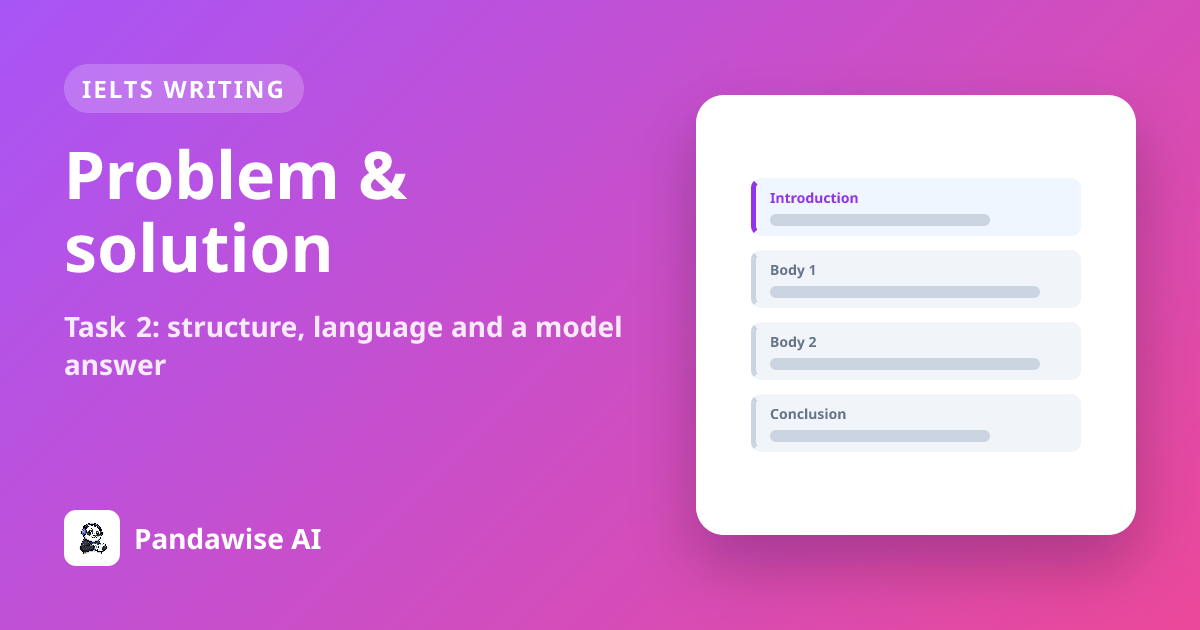
Here is a paragraph-by-paragraph plan for an IELTS problem solution essay structure:
| Paragraph | Purpose | What to Include |
|---|---|---|
| Introduction | Introduce the topic and outline your essay | Paraphrase the question, state that you will discuss causes and solutions |
| Body Paragraph 1 | Discuss the causes or problems | Two or three main causes, each with a brief explanation or example |
| Body Paragraph 2 | Propose solutions or measures | Two or three solutions that match the causes, with explanation |
| Conclusion | Summarise the main points | Restate the causes and solutions in a new way, without introducing new ideas |
This structure ensures you answer both parts of the question fully. The solutions in Body Paragraph 2 should logically address the causes in Body Paragraph 1. For example, if one cause is vehicle emissions, a matching solution could be promoting public transport.
During your planning minutes, jot down your ideas in note form. Do not write full sentences. This helps you organise your thoughts without wasting time.
Useful Language for an IELTS Problem Solution Essay
Using a range of appropriate vocabulary and structures can boost your Lexical Resource score. However, avoid overusing linking words or memorised phrases – this is a weakness, not a strength. The language below should be used naturally and only where it fits.
Language for Discussing Causes
- One significant cause of … is …
- This problem stems largely from …
- A major contributing factor is …
- … is primarily due to …
- Another key reason is …
Language for Proposing Solutions
- To address this issue, governments could …
- A practical measure would be to …
- One effective solution is …
- This could be mitigated by …
- It is essential that …
Language for Linking Ideas
- As a result, …
- Consequently, …
- Therefore, …
- In addition, …
- Furthermore, …
Remember, the best essays use linking words sparingly and rely more on logical progression of ideas. For more on how to approach different Task 2 types, see our guide on all IELTS Writing task types: Academic Task 1 visuals, General Training letters and Task 2 essays, with how to approach each.
High-Scoring Model Answer
Below is a model answer to the sample question, written in British English. It follows the structure above and demonstrates the features of a high-scoring essay.
Air pollution in major urban centres has become a pressing global concern, with many cities experiencing hazardous levels of contaminants. This essay will first examine the primary causes of this issue and then propose practical measures to combat it.
The main causes of urban air pollution are vehicle emissions and industrial activity. Firstly, the sheer number of private cars on the roads releases vast quantities of carbon monoxide and nitrogen oxides. In many cities, inadequate public transport systems force people to rely on their own vehicles, exacerbating the problem. Secondly, factories and power plants often burn fossil fuels, emitting sulphur dioxide and particulate matter. These industrial processes are frequently located near cities, where the workforce is concentrated, meaning that harmful pollutants are released directly into the urban atmosphere.
To tackle these causes, a combination of government intervention and technological innovation is required. With regard to traffic, authorities could invest in efficient and affordable public transport, such as electric buses and metro systems. This would encourage people to leave their cars at home. Additionally, stricter emissions standards for vehicles, coupled with incentives for electric car purchases, would reduce the pollution generated by those who still need to drive. As for industry, governments could enforce tighter regulations on factory emissions and offer tax breaks to companies that adopt cleaner energy sources, like solar or wind power. Furthermore, relocating heavy industry away from densely populated areas would lessen the direct impact on city dwellers.
In summary, vehicle emissions and industrial activities are the main drivers of air pollution in large cities. However, through investment in public transport, stricter regulations, and a shift towards renewable energy, these problems can be significantly alleviated.
Word count: 269
Why the Model Answer Works
This section breaks down the model answer according to the four IELTS marking criteria.
Task Response
The essay fully addresses both parts of the question. It identifies two main causes (vehicle emissions and industrial activity) and proposes specific, matching solutions. Each point is developed with explanation, and no irrelevant information is included. The conclusion summarises the key ideas without introducing new ones.
Coherence and Cohesion
The essay is logically organised. The introduction clearly states the purpose. Each body paragraph has a clear central topic, and ideas flow smoothly from one to the next. Linking words like “firstly”, “secondly”, and “with regard to” are used appropriately but not overused. The conclusion effectively wraps up the essay.
Lexical Resource
A range of topic-specific vocabulary is used accurately: “vehicle emissions”, “carbon monoxide”, “nitrogen oxides”, “fossil fuels”, “sulphur dioxide”, “particulate matter”, “renewable energy”. There is also some less common phrasing, such as “exacerbating the problem” and “alleviated”. The language is natural and not forced.
Grammatical Range and Accuracy
The essay demonstrates a mix of simple and complex sentence structures. For example, “In many cities, inadequate public transport systems force people to rely on their own vehicles, exacerbating the problem” uses a participle clause. There are no grammatical errors, and punctuation is correct throughout.
Common Mistakes That Lower the Band
Avoid these frequent errors in your IELTS problem solution essay:
- Not answering the exact question: If the prompt asks for “causes”, do not write about “effects”. Read the question carefully and stick to what is asked.
- Causes and solutions that do not match: If you say the cause is too many cars, the solution should address cars, not something unrelated like littering. Ensure each solution logically follows from a cause.
- Listing ideas without development: Simply stating “One cause is cars. Another is factories.” is not enough. Explain how or why each point is relevant.
- Overusing linking words: Starting every sentence with “Firstly”, “Secondly”, “Moreover” makes writing mechanical. Use a variety of cohesive devices and rely on logical flow.
- Writing a memorised essay: Examiners are trained to spot template answers. Your essay should be a genuine response to the specific question, not a pre-learned structure with gaps filled in.
- Ignoring word count: Writing fewer than 250 words will lose you marks. Aim for 270–300 words to be safe, but do not write excessively as this may introduce errors.
- Weak conclusions: A conclusion that simply repeats the introduction or introduces new ideas is ineffective. Summarise your main points in a fresh way.
For more detailed guidance on other Task 2 types, you might find our articles on IELTS Writing Task 2 opinion essays (agree or disagree) and IELTS Writing Task 2 discussion essays (discuss both views and give your opinion) helpful.
How to Practise and Key Takeaways
Consistent, focused practice is the most effective way to improve. Use real IELTS-style questions and time yourself strictly. After writing, review your work against the four criteria, or ask a teacher for feedback. You can also practise with guided lessons on IELTS Writing lessons to receive structured support.
Key Takeaways
- An IELTS problem solution essay requires you to discuss causes (or problems) and propose solutions that directly address them.
- Follow a clear four-paragraph structure: introduction, causes, solutions, conclusion.
- Spend up to five minutes planning to ensure your ideas are relevant and well-organised.
- Use a range of vocabulary and grammar naturally; avoid memorised phrases and overused linking words.
- Always check that your solutions logically match the causes you have identified.
- Aim for at least 250 words, and leave time to proofread for errors.
Write it and get feedback on every criterion
Exam-style writing tasks marked by an AI examiner on all four criteria, with a band for each.
Explore the appFrequently asked questions
What is the difference between a problem solution essay and a causes and solutions essay in IELTS?
A problem solution essay asks you to discuss the negative effects of an issue and then suggest solutions. A causes and solutions essay asks you to explain why a problem exists and then propose measures. The key difference is whether you focus on causes or effects. Always read the prompt carefully to determine which is required.
How many causes and solutions should I include in my IELTS problem solution essay?
You should include two or three main causes and a matching number of solutions. It is better to develop a few points fully with explanations and examples than to list many ideas superficially. Quality and development are more important than quantity.
Can I write about both causes and effects in an IELTS problem solution essay?
Only if the question specifically asks for both. Most prompts ask for either causes or problems, not both. Writing about effects when the question asks for causes will lower your Task Response score. Stick precisely to what the prompt instructs.
Do I need a conclusion in an IELTS problem solution essay?
Yes, a conclusion is essential. It should briefly summarise the main causes and solutions without introducing new ideas. A good conclusion helps your Coherence and Cohesion score by giving your essay a clear sense of closure.
How is the IELTS problem solution essay scored?
It is scored on four criteria, each worth 25%: Task Response (how well you answer the question), Coherence and Cohesion (organisation and linking), Lexical Resource (vocabulary range and accuracy), and Grammatical Range and Accuracy. All four are equally important for a high score.