Question Types
IELTS Reading Multiple Choice: Tips, Strategy and Practice
Learn how to answer IELTS Reading multiple choice questions efficiently. This guide covers a clear strategy, common mistakes and a worked example to boost your score.
Pandawise AI · Updated · 13 min read
In this guide
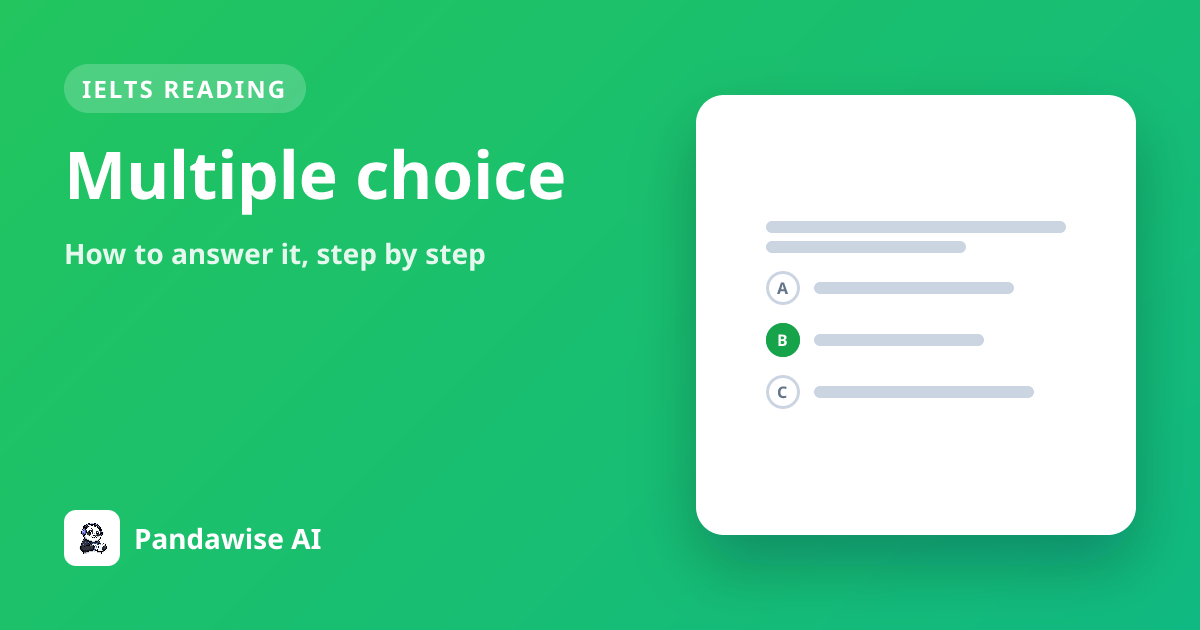
Multiple choice questions are a common feature of the IELTS Reading test, and the version with a single correct answer can appear in both the Academic and General Training modules. These questions test your ability to understand specific details, identify the writer’s overall purpose or select the most suitable title for a passage. While the format may seem familiar from other exams, IELTS Reading multiple choice questions are carefully designed to check whether you can distinguish between similar ideas, recognise paraphrasing and avoid distractors. This guide gives you a clear, step-by-step approach to tackling them, along with a realistic example and practical advice on how to practise effectively.
What are IELTS Reading multiple choice questions?
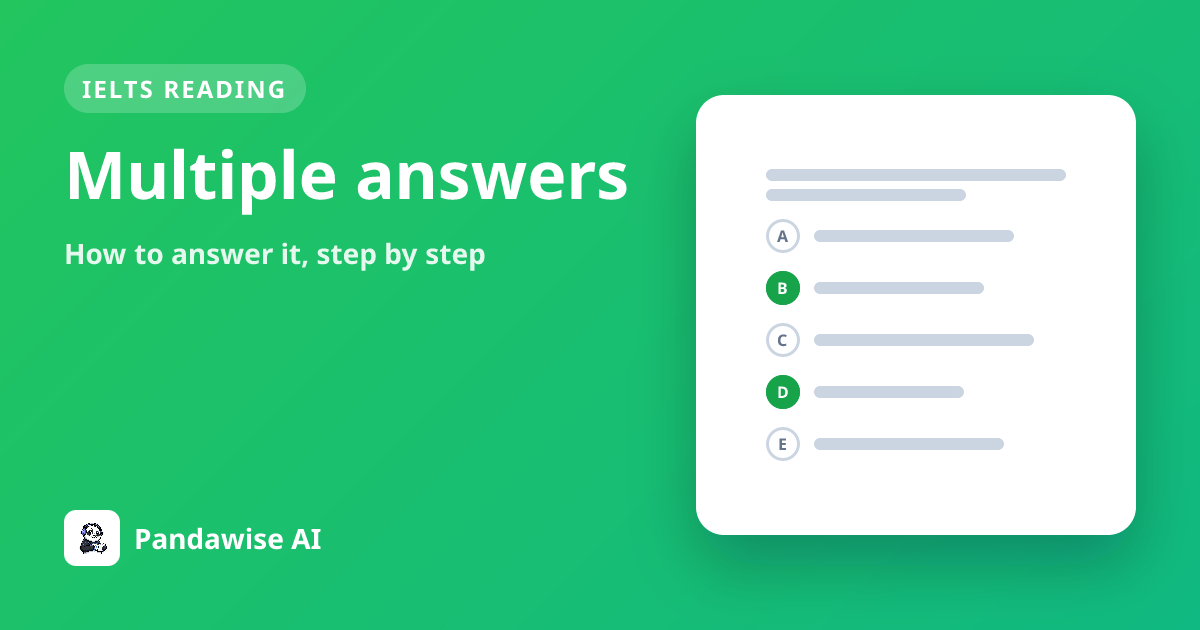
In this question type, you see a question or an unfinished sentence followed by four options labelled A, B, C and D. Your task is to choose the one option that correctly answers the question or completes the sentence. Unlike the multiple choice variant where you choose two or more answers from a longer list, here you select only one letter and write it on your answer sheet.
IELTS Reading multiple choice items usually follow the order of information in the passage. This means that the answer to the first question is likely to be found before the answer to the second question, and so on. However, some questions ask about the passage as a whole, for example “What is the best title for the passage?” or “What is the writer’s main purpose?”. These global questions require you to consider the entire text and are often placed at the end of a set.
In the Academic Reading test, multiple choice questions can appear in any of the three long passages, which are taken from books, journals, magazines and newspapers. The passages become progressively more difficult, so a multiple choice set in Passage 3 may involve more complex arguments and denser paraphrasing. In the General Training Reading test, they can appear in any section: the short factual texts of Section 1, the workplace-related texts of Section 2, or the longer general-interest passage in Section 3.
What the questions look like
Before the questions, you see an instruction line in bold. For a single-answer multiple choice task, it reads:
Choose the correct letter, A, B, C or D.
Below this, the questions are presented as either direct questions or sentence stems with four possible endings. Here is a realistic example based on a passage about the history of glassmaking.
The origins of glass
A. Natural glass has existed since the beginnings of time, formed when certain types of rock melt at high temperatures and then cool rapidly. The most familiar example, obsidian, was used by Stone Age societies for cutting tools and weapons. The earliest man-made glass objects, mainly beads and small vessels, date back to around 3500 BC in Mesopotamia. However, it was not until the Roman period that glassblowing revolutionised production and made glass items accessible to ordinary people.
B. The basic ingredients of glass – sand, soda ash and limestone – have remained largely unchanged for thousands of years. These materials are heated in a furnace to about 1700°C until they fuse into a molten liquid. When this liquid cools, it hardens without forming a crystalline structure, giving glass its characteristic transparency. Small adjustments in the proportions or the addition of metal oxides can produce a wide range of colours, from deep blue to rich red.
C. During the Middle Ages, Venice became the centre of European glassmaking, with the island of Murano particularly famous for its skilled artisans. The Venetian authorities guarded their techniques so closely that glassworkers were forbidden to leave the island. Despite these restrictions, knowledge gradually spread, and by the 17th century, new centres of production had emerged in Bohemia, England and France, each developing its own distinctive styles.
Questions 1–4
Choose the correct letter, A, B, C or D.
-
According to paragraph A, obsidian A. was the first man-made glass. B. was used before the invention of glassblowing. C. is a type of naturally occurring glass. D. was shaped into beads in Mesopotamia.
-
What does paragraph B say about the colour of glass? A. It is determined by the temperature of the furnace. B. It can be altered by adding certain substances. C. It has become brighter over time. D. It depends mainly on the type of sand used.
-
In paragraph C, why does the writer mention that glassworkers were forbidden to leave Murano? A. To explain why Venice’s glass industry declined. B. To illustrate how the authorities tried to protect their secrets. C. To show that glassworkers were poorly treated. D. To suggest that Murano glass was of low quality.
-
What is the best title for the passage? A. The science of modern glass production B. Glassblowing: a Roman invention C. A brief history of glassmaking D. The economic importance of glass in Venice
Step-by-step strategy for multiple choice questions
A systematic approach is essential for IELTS Reading multiple choice tasks because the distractors are designed to catch you out if you rely on memory or guesswork. Follow these steps to maximise your accuracy while keeping an eye on the clock.
1. Read the instructions and the questions first
Before you look at the passage, read the instruction line to confirm you are dealing with a single-answer multiple choice set. Then read the first question and all four options carefully. Do not read all the questions at once; focus on one at a time. Underline key words in the question stem and in each option. For example, in question 1 above, key words might be “obsidian”, “first man-made”, “naturally occurring” and “Mesopotamia”. This prepares your brain to spot relevant information when you scan the passage.
2. Locate the relevant part of the passage
Use the key words you underlined to find the section of the passage that contains the answer. Because the questions usually follow the order of the text, the answer to question 1 will be in an earlier part of the passage than the answer to question 2. In our example, the word “obsidian” appears only in paragraph A, so you can go straight there. Do not read the whole passage in detail at this stage; scan for the key words and then read the surrounding sentences carefully.
3. Read the relevant sentences intensively
Once you have located the right place, read it slowly and compare it with each option. The correct answer will be a paraphrase of the passage, not a word-for-word match. For instance, if the passage says “obsidian … used by Stone Age societies for cutting tools”, the correct option might say “was used in prehistoric times”. Be aware that wrong options often contain words lifted directly from the passage to seem familiar, but they change the meaning slightly or add information that is not there.
4. Eliminate obviously wrong options
Go through the four options one by one and cross out those that are clearly incorrect. Common reasons to eliminate an option include:
- It contradicts the passage.
- It is true according to the passage but does not answer the question.
- It is too broad or too narrow.
- It uses words from the passage but in a different context.
Narrowing down the choices reduces the chance of being distracted and helps you focus on the remaining possibilities.
5. Confirm your choice and move on
When you have selected an answer, quickly re-read the relevant sentence in the passage to make sure your choice is fully supported. Then write the letter on your answer sheet immediately. In the paper-based test, there is no extra transfer time, so you must record your answers within the 60 minutes. Do not leave any blanks; there is no penalty for a wrong answer, so always make an educated guess if you are unsure.
6. Repeat for the next question
Move to the next question and repeat the process. Remember that the answer will usually be found later in the passage than the previous one. For global questions, such as choosing the best title, you may need to review the main idea of each paragraph after you have answered the detail questions. This is efficient because by then you already have a good understanding of the passage.
Time management note
As a rule of thumb, you have about 20 minutes per section. If a multiple choice set has four questions, aim to spend no more than 6–7 minutes on it. If you get stuck on one question, make a quick guess, mark it for review if you have time at the end, and move on. Losing time on a single question can jeopardise your performance on later, perhaps easier, questions.
Worked example: answers explained
Let’s go through the sample questions one by one, showing exactly how to find the answer and why the wrong options are tempting but incorrect.
Question 1: According to paragraph A, obsidian …
- Passage text: “Natural glass has existed since the beginnings of time … The most familiar example, obsidian, was used by Stone Age societies for cutting tools and weapons.”
- Correct answer: C. is a type of naturally occurring glass. This is a paraphrase of “Natural glass … The most familiar example, obsidian”.
- Why the others are wrong:
- A: “was the first man-made glass.” The passage says obsidian is natural glass, not man-made. The phrase “man-made glass” appears later in the paragraph, which can mislead you.
- B: “was used before the invention of glassblowing.” This is true – obsidian was used in the Stone Age, long before glassblowing – but the question asks what paragraph A says about obsidian, and this comparison is not made in the text. It is a true statement that does not answer the question.
- D: “was shaped into beads in Mesopotamia.” The passage mentions beads in Mesopotamia, but in connection with “the earliest man-made glass objects”, not obsidian. Words from the passage are mixed up to create a false statement.
Question 2: What does paragraph B say about the colour of glass?
- Passage text: “Small adjustments in the proportions or the addition of metal oxides can produce a wide range of colours, from deep blue to rich red.”
- Correct answer: B. It can be altered by adding certain substances. “Adding certain substances” paraphrases “the addition of metal oxides”.
- Why the others are wrong:
- A: “It is determined by the temperature of the furnace.” The furnace temperature is mentioned for melting, not for colour.
- C: “It has become brighter over time.” There is no comparison of brightness across time in the passage.
- D: “It depends mainly on the type of sand used.” Sand is a basic ingredient, but the passage does not link sand type to colour.
Question 3: In paragraph C, why does the writer mention that glassworkers were forbidden to leave Murano?
- Passage text: “The Venetian authorities guarded their techniques so closely that glassworkers were forbidden to leave the island.”
- Correct answer: B. To illustrate how the authorities tried to protect their secrets. “Guarded their techniques so closely” is paraphrased as “tried to protect their secrets”.
- Why the others are wrong:
- A: “To explain why Venice’s glass industry declined.” The passage does not mention a decline; it says knowledge spread despite the restrictions.
- C: “To show that glassworkers were poorly treated.” The passage does not discuss treatment, only the restriction on leaving.
- D: “To suggest that Murano glass was of low quality.” The passage implies the opposite: the techniques were valuable enough to guard.
Question 4: What is the best title for the passage?
- The passage moves from natural glass and early man-made glass (A), to basic ingredients and properties (B), to historical centres of production (C).
- Correct answer: C. A brief history of glassmaking. This covers the chronological and thematic scope of all three paragraphs.
- Why the others are wrong:
- A: “The science of modern glass production.” The passage does not focus on modern production; it covers history and basic science only briefly.
- B: “Glassblowing: a Roman invention.” Glassblowing is mentioned in one sentence; the passage is much broader.
- D: “The economic importance of glass in Venice.” Venice appears only in paragraph C; this is too specific.
Common mistakes and traps
Even well-prepared candidates can fall into the traps set by the test writers. Here are the most frequent pitfalls in IELTS Reading multiple choice questions and how to avoid them.
- Choosing an option just because it contains words from the passage. Distractors often repeat key vocabulary from the text but change the meaning. Always check the whole idea, not just individual words.
- Selecting an answer that is true but does not answer the question. As seen in question 1, option B, a statement can be factually correct according to the passage yet still be the wrong choice because it does not address the specific question asked.
- Failing to recognise paraphrases. The correct answer rarely uses the same wording as the passage. If you look only for matching words, you may miss the right option. Train yourself to think in terms of synonyms and rephrased ideas.
- Answering from your own knowledge. The questions test your understanding of the passage, not your general knowledge. An option may be true in the real world but unsupported by the text, making it incorrect.
- Spending too long on one question. Multiple choice questions can be time-consuming because you need to evaluate four options. If you are stuck, eliminate the ones you know are wrong, guess from the remaining options and move on. You can mark the question and return to it if time allows.
- Ignoring the question stem. Read both the stem and the options with equal care. A stem like “According to paragraph B…” restricts the answer to that paragraph; information from elsewhere in the passage is irrelevant for that question.
How to practise multiple choice questions effectively
Targeted practice is the key to improving your performance on IELTS Reading multiple choice tasks. Here are some concrete exercises you can do regularly.
- Paraphrase recognition drills. Take a short paragraph from an English-language article. Write a simple factual statement about it, then rewrite that statement in three different ways using synonyms and different sentence structures. This trains your brain to spot paraphrases quickly.
- Distractor analysis. After completing a set of multiple choice questions, do not just check the correct answers. For each wrong option, write down exactly why it is wrong, using the categories mentioned above (contradicts the passage, true but irrelevant, etc.). This builds your awareness of common traps.
- Timed scanning practice. Choose a passage of about 250 words and give yourself 60 seconds to find a specific piece of information (a name, a date, a term). This improves your ability to locate key words quickly, which is essential for step 2 of the strategy.
- Whole-passage timing. Once a week, complete a full Reading passage with all its question types under strict timed conditions (20 minutes). Include the answer transfer step to simulate the real test experience.
- Use focused online practice. For structured lessons that target each IELTS Reading question type, including multiple choice, you can try the IELTS Reading lessons on Pandawise. They provide guided practice with instant feedback to help you refine your technique.
For a broader understanding of the test, you may also find these related guides useful:
- All IELTS Reading question types: an overview of the test and of each type, with how to approach it
- IELTS Reading True / False / Not Given questions
- IELTS Reading matching headings questions
Key takeaways
- IELTS Reading multiple choice questions with one answer require you to select the correct option from four choices, and they usually follow the order of the passage.
- Always read the question stem and options before scanning the passage, and underline key words to guide your search.
- The correct answer is a paraphrase of the passage; wrong options often use the same words but change the meaning or do not answer the question.
- Eliminate obviously incorrect options first to narrow down your choices and save time.
- For global questions, consider the main idea of each paragraph after you have answered the detail questions.
- Practise regularly with timed exercises and distractor analysis to build both speed and accuracy.
Practise multiple choice questions
Exam-style passages and practice tests with instant marking and the evidence for every answer.
Explore the appFrequently asked questions
How many multiple choice questions are there in IELTS Reading?
There is no fixed number. Multiple choice questions can appear in any of the three sections, and you might see one set of four or five questions, or none at all. The total number varies from test to test, so you should be prepared for them but not expect a specific quantity.
Do multiple choice questions in IELTS Reading follow the order of the passage?
Yes, in most cases the questions follow the order of information in the passage. This means the answer to question 1 will appear earlier in the text than the answer to question 2. However, questions that ask about the whole passage, such as choosing the best title, are an exception and may require you to consider the entire text.
What is the difference between single-answer and multiple-answer multiple choice in IELTS Reading?
In single-answer multiple choice, you choose one correct letter from four options (A–D). In the multiple-answer version, you are usually asked to choose two or three correct letters from a longer list of options, and the instructions will say something like ‘Choose TWO letters, A–E’. The latter is less common but tests similar skills.
How can I avoid being tricked by wrong options in IELTS Reading multiple choice?
Focus on meaning, not just matching words. Wrong options often repeat vocabulary from the passage but change the idea slightly, or they state something true that does not answer the question. Always check the option against the exact wording of the passage, and eliminate any choice that is not fully supported.
Should I guess if I run out of time on an IELTS Reading multiple choice question?
Yes, always guess. There is no penalty for incorrect answers, so leaving a blank means you definitely lose a mark. If you have a few seconds, quickly eliminate any options you know are wrong and choose from the remaining ones to increase your chance of guessing correctly.