Question Types
IELTS Reading Question Types: Complete Overview and Tips
A complete overview of every IELTS Reading question type, from True/False/Not Given to diagram labelling. Includes test format, key tips for each type, and time management strategies.
Pandawise AI · Updated · 13 min read
In this guide
Understanding the IELTS Reading question types is a key step towards a higher band score. The Reading paper is the same for both the Academic and General Training modules in terms of question styles, but the texts differ. This guide gives you a clear overview of the IELTS Reading test format, then walks you through every question type you might meet on test day. You will learn what each type tests, how to approach it, and where to find a full step-by-step guide. We finish with strategies that work across all types of questions in IELTS Reading, including skimming, scanning and time management.
The IELTS Reading Test at a Glance
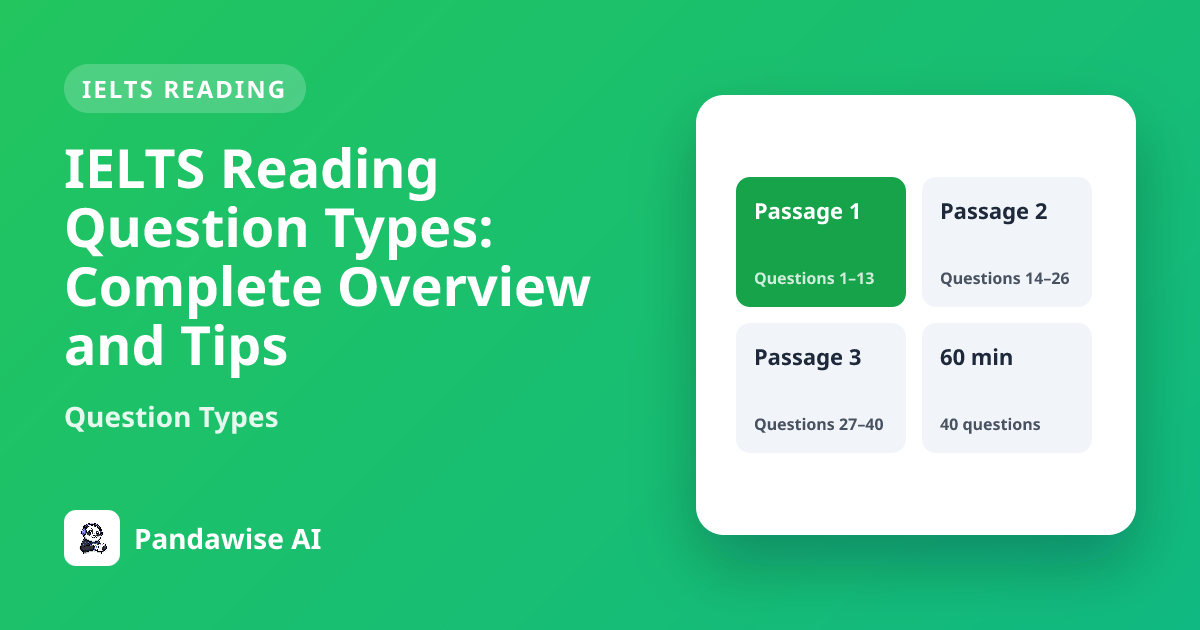
Before we look at individual question types, let us get the basics clear. The Reading test lasts 60 minutes and contains 40 questions. There is no extra time to transfer answers. If you take the paper-based test, you must write your answers directly onto the answer sheet within the 60 minutes. On a computer, you type your answers as you go.
Every question is worth one mark. There is no penalty for a wrong answer, so never leave a blank. Roughly 30 correct answers out of 40 give Band 7.0 in Academic Reading, while General Training usually needs around 34 out of 40 for the same band. The exact conversion varies slightly between tests.
The table below compares the two modules.
| Feature | Academic Reading | General Training Reading |
|---|---|---|
| Number of sections | 3 | 3 |
| Text types | 3 long passages from books, journals, magazines and newspapers | Section 1: 2–3 short everyday texts (notices, adverts, timetables); Section 2: 2 workplace texts (job descriptions, contracts, staff guides); Section 3: 1 longer text of general interest |
| Difficulty | Passages get harder from Passage 1 to Passage 3 | Sections progress from everyday to more complex texts |
| Question types | Same across both modules | Same across both modules |
| Timing guideline | About 20 minutes per section | About 20 minutes per section |
Whichever module you take, the IELTS Reading question types are identical. Let us now look at each one.
The IELTS Reading Question Types
There are 16 distinct question types. Each tests a slightly different reading skill, but they all rely on your ability to locate information quickly and understand paraphrased ideas. For every type, the instructions tell you exactly what to do, including any word limit. A limit like "CHOOSE NO MORE THAN TWO WORDS" means that writing three words makes your answer wrong, even if the meaning is correct. Spelling must be accurate. In completion and short-answer tasks, you must take words directly from the passage.
Below, each type gets its own short section. Click the link at the end for a detailed guide with examples and practice.
True / False / Not Given
This type gives you a list of statements. You decide if each statement agrees with the information in the passage (True), contradicts it (False), or if there is no information about it at all (Not Given). It tests your ability to separate facts in the text from your own assumptions. The key tip: base your answer only on what the passage says, not on what you think is true. If you cannot find clear evidence for or against the statement, the answer is Not Given.
IELTS Reading True / False / Not Given questions
Yes / No / Not Given
This is very similar to True / False / Not Given, but the statements express the writer's views or claims rather than factual information. You decide if each statement matches the writer's opinion (Yes), contradicts it (No), or is not mentioned (Not Given). The skill tested is recognising opinion and attitude. The same rule applies: look for evidence in the text. If the writer does not express a view on that point, choose Not Given.
IELTS Reading Yes / No / Not Given questions
Multiple Choice (One Answer)
You see a question or an incomplete sentence followed by four options (A–D). You choose the one correct answer. This type tests detailed understanding of a specific part of the passage. The options often contain distractors—words from the passage used in a different way. The key tip: eliminate obviously wrong options first, then check the remaining ones against the passage. The correct answer will paraphrase the information, not repeat it word for word.
IELTS Reading multiple choice questions (one answer)
Multiple Answers
Here, you are asked to choose two correct answers from a list of five or more options (A–E or A–F). You must write two letters on your answer sheet. This type often tests your ability to identify two reasons, two examples, or two features mentioned in a part of the text. The answers can come in any order. Read the list of options before you scan the passage so you know what to look for.
IELTS Reading multiple answers questions
Matching Headings
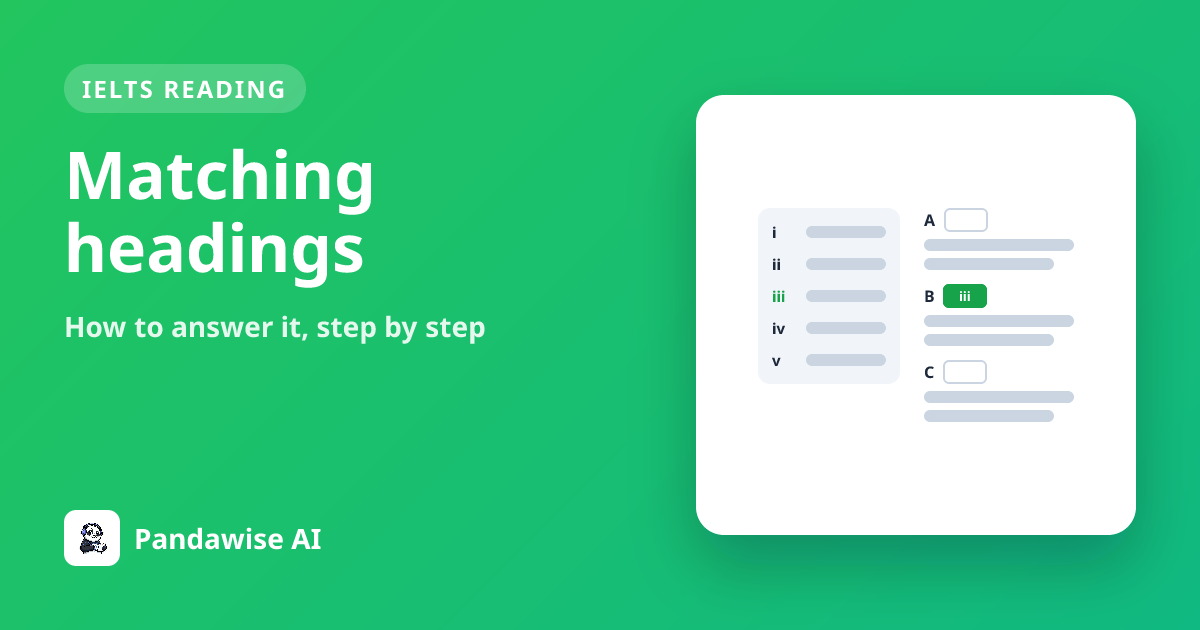
You are given a list of headings, usually labelled with Roman numerals (i, ii, iii…). Your task is to match each heading to the correct paragraph or section of the passage. There are always more headings than paragraphs, so some headings will not be used. This type tests your ability to identify the main idea of each paragraph. The key tip: read the first and last sentences of the paragraph carefully, as the main idea often appears there. Do not match based on a single matching word; look for the overall message. Answers do not follow passage order.
IELTS Reading matching headings questions
Matching Information
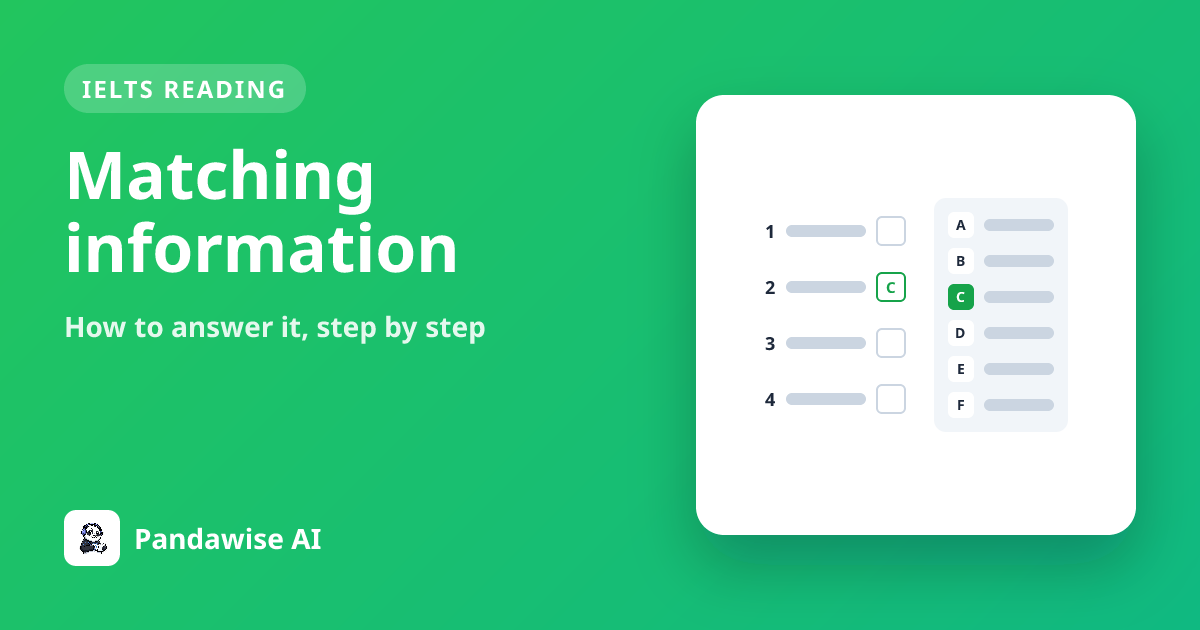
This type asks "Which paragraph contains the following information?" You see a list of pieces of information, and you write the letter of the paragraph where each is found. A paragraph may be used more than once, and some paragraphs may not be used at all. This tests your ability to scan for specific details. The information is paraphrased, so look for synonyms. Remember, answers do not come in passage order.
IELTS Reading matching information questions (which paragraph contains...)
Matching Features
You match a set of items (e.g., people, dates, theories) to a set of statements or findings. The items are usually listed in a box. This type tests your ability to connect information across the passage and recognise relationships. The key tip: scan the passage for the names or items, then read around them to find the matching statement. Answers do not follow passage order.
IELTS Reading matching features questions
Matching Sentence Endings
You see the first halves of sentences and a list of possible endings. You match each beginning to the correct ending to form a sentence that is true according to the passage. There are more endings than beginnings. This type tests your understanding of how ideas are connected. The key tip: complete each sentence grammatically and logically, then check that the meaning matches the passage. The answers usually come in passage order.
IELTS Reading matching sentence endings questions
Sentence Completion
You complete sentences with words taken directly from the passage. A word limit is always given (e.g., NO MORE THAN TWO WORDS). This type tests your ability to locate specific information and understand detail. The sentences paraphrase the passage, so identify the keywords in the question and scan for their synonyms. Make sure your answer fits the sentence grammatically and stays within the word limit.
IELTS Reading sentence completion questions
Short-Answer Questions
You answer questions using words taken directly from the passage. A word limit is always stated. This type tests your ability to find and understand specific facts. The questions are in passage order. The key tip: identify the question words (who, what, when, where, how many) to know what kind of information you need. Then scan for that information. Your answer must be exactly as it appears in the passage.
IELTS Reading short-answer questions
Summary Completion (Words from the Passage)
You complete a summary of part of the passage using words taken from the text. A word limit is given. The summary may cover a whole passage or just one part. This type tests your ability to understand the main ideas and supporting details of a section. The key tip: read the summary first to understand the context, then locate the relevant part of the passage. The answers usually come in order within the summary.
IELTS Reading summary completion questions (words from the passage)
Summary Completion with a Word List
This is similar to the above, but you choose answers from a box of words instead of taking them from the passage. The words in the box may include distractors. This type tests your ability to understand meaning and choose the correct word from a set of options. The key tip: read the summary to predict what type of word is needed (e.g., a noun, a verb), then look at the word list. Check that your choice fits grammatically and matches the passage meaning.
IELTS Reading summary completion with a list of words (word box)
Note Completion
You complete a set of notes with words from the passage. The notes are structured like bullet points or a short list. A word limit is given. This type tests your ability to pick out key facts and details. The key tip: use the headings and layout of the notes to guide you to the right part of the passage. The answers usually come in order.
IELTS Reading note completion questions
Table Completion
You complete a table with words from the passage. The table organises information into rows and columns. A word limit is given. This type tests your ability to locate and categorise information. The key tip: look at the row and column headings to understand what information is needed. Then scan the passage for those details. The answers often appear in order across the rows.
IELTS Reading table completion questions
Flow-Chart Completion
You complete a flow chart that summarises a process or sequence from the passage. Arrows show the order of steps. A word limit is given. This type tests your ability to follow a sequence of events or stages. The key tip: identify the starting point in the passage and follow the order of the flow chart. The answers usually appear in the order of the steps.
IELTS Reading flow-chart completion questions
Diagram Label Completion
You label a diagram (e.g., a machine, a building, a natural feature) using words from the passage. A word limit is given. This type tests your ability to relate a visual representation to a written description. The key tip: study the diagram before you read the relevant part of the passage. Note the parts that need labels, then find the description in the text. The answers may not come in passage order; they follow the diagram.
IELTS Reading diagram label completion questions
Strategies for Every Type
While each question type has its own approach, some core strategies apply across the whole Reading test. Mastering these will help you handle any IELTS Reading question types you face.
Skim First, Then Scan
Skimming means reading quickly to get the general meaning—the topic, the main idea of each paragraph, the structure. Spend about 2–3 minutes skimming a passage before you look at the questions. This gives you a mental map. Then, when a question asks about a specific detail, you scan the passage to find it. Scanning is moving your eyes quickly over the text to locate a particular word, name, number or synonym. Do not read every word during scanning.
Paraphrase Awareness
Questions almost never use the same words as the passage. They paraphrase. For example, the passage might say "urban development accelerated in the 20th century," and the question might say "city growth became faster after 1900." Train yourself to think in synonyms. When you read a question, underline the key words and think of other ways to express them. Then scan for those synonyms.
Manage Your 60 Minutes
The test is 60 minutes with no transfer time. You must pace yourself. A common guideline is 20 minutes per section, but you can adjust this. If you find Passage 1 easier, you might spend 17 minutes on it and give 23 minutes to Passage 3, which is usually harder. Keep an eye on the clock. If you are stuck on one question, make a guess, mark it, and move on. You can come back if you have time at the end.
Use Passage Order to Your Advantage
For most question types, the answers come in the order of the passage. This is true for True/False/Not Given, Yes/No/Not Given, sentence completion, short-answer questions, and all completion types (notes, table, flow-chart, diagram, summary). Knowing this helps you locate answers efficiently. If you find the answer to question 5, the answer to question 6 will be later in the passage, not before. The exceptions are matching headings, matching information, and matching features—these do not follow passage order.
Read Instructions Carefully
Every question set has instructions. They tell you the word limit and what you must do. Ignoring the word limit is a common mistake that costs marks. If the instruction says "NO MORE THAN TWO WORDS AND/OR A NUMBER," you can write one word, two words, a number, or a word and a number. Writing three words makes the answer wrong. Also, check whether you need to use words from the passage or choose from a list.
Never Leave a Blank
There is no negative marking. A wrong answer gets zero, but a blank also gets zero. If you are running out of time, write something for every question. For multiple choice, pick one letter. For completion tasks, write a word from the passage that seems plausible. You have a chance of being right, but a blank has no chance.
Mistakes That Cost Marks
Even strong candidates lose marks to avoidable errors. Here are the most common ones across all IELTS Reading question types.
- Exceeding the word limit. If the limit is two words and you write three, the answer is marked wrong, even if the meaning is correct. Count your words.
- Spelling errors. In completion and short-answer tasks, your spelling must match the passage exactly. British and American spellings are both accepted, but the word must be spelled correctly.
- Copying words incorrectly. When you transfer an answer, you might miss a letter or add an extra one. Check carefully.
- Using your own knowledge. The True/False/Not Given and Yes/No/Not Given types test what the passage says, not what you know about the topic. Base every answer on the text.
- Matching single words. In matching headings, do not choose a heading just because it contains a word from the paragraph. The heading must reflect the paragraph's main idea.
- Spending too long on one question. If a question is difficult, guess, mark it, and move on. You can lose several minutes that you need for later questions.
How to Practise
Regular, focused practice is the best way to improve. Start by working on one question type at a time until you understand its rules and strategies. Use the full guides linked in each section above for step-by-step practice. Then move on to full Reading passages under timed conditions. After each practice session, analyse your mistakes. Did you misread the instruction? Did you miss a paraphrase? Did you run out of time? Understanding why you got an answer wrong is more valuable than just checking the score.
When you are ready for targeted feedback, you can practise with IELTS Reading lessons that adapt to your level and help you build skills type by type.
Key Takeaways
- The Reading test has 40 questions in 60 minutes with no extra transfer time.
- The IELTS Reading question types are the same in Academic and General Training; only the texts differ.
- For most types, answers come in passage order—except matching headings, matching information and matching features.
- Always check the word limit and spelling; they can make an otherwise correct answer wrong.
- Paraphrase is the key: questions rephrase the passage, so look for synonyms.
- Skim for the main idea, scan for specific details.
- Never leave a blank; there is no penalty for guessing.
- Practise each type individually, then combine them under timed conditions.
Practise IELTS Reading
Exam-style passages and practice tests with instant marking and the evidence for every answer.
Explore the appFrequently asked questions
How many question types are there in IELTS Reading?
There are 16 distinct question types in the IELTS Reading test. They range from True/False/Not Given and multiple choice to matching headings, sentence completion, and diagram labelling. All types appear in both the Academic and General Training modules, although the texts themselves differ between the two.
Do IELTS Reading questions follow the order of the passage?
Most question types do follow the order of the passage. This includes True/False/Not Given, Yes/No/Not Given, sentence completion, short-answer questions, and all completion tasks like notes, tables, and summaries. The main exceptions are matching headings, matching information, and matching features, which do not follow passage order.
What is the difference between True/False/Not Given and Yes/No/Not Given?
True/False/Not Given questions deal with factual information in the passage. You decide if statements are true, false, or not given based on facts. Yes/No/Not Given questions deal with the writer's views or claims. You decide if statements match the writer's opinion (Yes), contradict it (No), or are not mentioned (Not Given).
How can I manage my time in the IELTS Reading test?
Divide your 60 minutes roughly into 20 minutes per section. Skim each passage for 2–3 minutes before looking at the questions. If you get stuck on a question, guess, mark it, and move on. Return to it at the end if you have time. Remember there is no extra time to transfer answers, so write directly on the answer sheet.
Are spelling mistakes penalised in IELTS Reading?
Yes, spelling must be correct in completion and short-answer tasks. If you copy a word from the passage and spell it incorrectly on your answer sheet, the answer is marked wrong. Both British and American spellings are accepted, but the word must be spelled accurately.