Question Types
IELTS Reading Matching Features: Tips, Example and Strategy
Learn how to tackle IELTS Reading matching features questions. This guide covers a clear strategy, a worked example, and tips to match statements to people or theories quickly and accurately.
Pandawise AI · Updated · 10 min read

In this guide
Matching features questions are a common challenge in the IELTS Reading test. In this type, you must match a list of statements to a set of features—usually researchers, experts or theorists—labelled A, B, C and so on. This guide explains exactly what IELTS Reading matching features questions involve, gives you a reliable step-by-step strategy, and shows you how to avoid the mistakes that cost marks. By the end, you will know how to scan for names, compare what is said about each person, and handle the fact that statements do not appear in passage order.
What Are IELTS Reading Matching Features Questions?
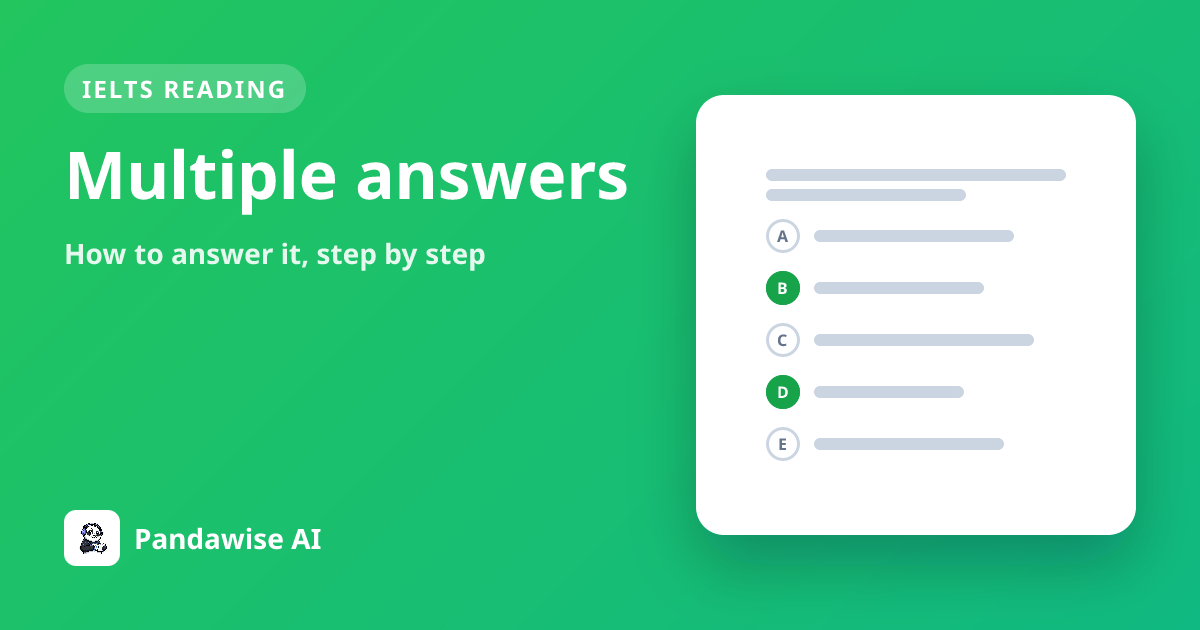
In IELTS Reading matching features tasks, you see a box containing a list of features (often people, but sometimes dates, places, theories or organisations) labelled with letters. Below that, there is a set of statements. Your job is to match each statement to the correct feature by writing the appropriate letter on your answer sheet.
Key characteristics of this question type:
- The features are usually researchers, scientists or experts mentioned in the passage.
- Options can be used more than once, and some options may not be used at all.
- The statements are not in the same order as the information in the passage.
- The instructions always appear in bold at the top of the question set.
You will find matching features questions in both the Academic and General Training modules. In Academic Reading, they often appear in Passage 2 or Passage 3, where texts are more discursive and present multiple viewpoints. In General Training Reading, they are most likely in Section 3, the longer, more complex text of general interest. Because the answers do not follow passage order, this question type tests your ability to locate specific information quickly and to understand paraphrased ideas.
What the Questions Look Like
Here is a realistic example of IELTS Reading matching features questions, based on the style you will see on test day. The instruction line is shown exactly as it appears in the test.
Questions 1–4
Look at the following statements (Questions 1–4) and the list of researchers below.
Match each statement with the correct researcher, A, B or C.
Write the correct letter, A, B or C, in boxes 1–4 on your answer sheet.
NB You may use any letter more than once.
List of Researchers
A. Dr Elena Torres B. Professor James Okonkwo C. Dr Mei Lin
The Origins of Laughter
A. For decades, scientists have debated why humans laugh. Dr Elena Torres, a neuroscientist at the University of Barcelona, argues that laughter evolved as a social bonding mechanism. Her research shows that laughter is far more likely to occur in group settings than when a person is alone. She also points out that the brain releases endorphins during genuine laughter, reinforcing social connections.
B. Professor James Okonkwo, a psychologist at the University of Cape Town, takes a different view. He believes laughter originated as a signal of safety. In his studies, he found that chimpanzees produce laugh-like sounds during play-fighting to indicate that the interaction is not a real threat. He suggests that early humans used laughter in a similar way, to show that a surprising event was not dangerous.
C. Dr Mei Lin, an evolutionary biologist at the University of Tokyo, has proposed a third explanation. She contends that laughter began as a way to attract a mate. Her analysis of laughter patterns across cultures reveals that women tend to laugh more often in the presence of men they find attractive, and that men are more likely to produce humour in such situations. She believes this behaviour increased reproductive success in early human societies.
- Laughter may have developed as a way of indicating that there is no danger.
- The release of certain chemicals in the brain helps to strengthen relationships between individuals.
- Humour is often used to gain the attention of a potential partner.
- The context in which laughter happens is more important than the individual’s emotional state.
Step-by-Step Strategy for Matching Features
Follow this strategy to answer IELTS Reading matching features questions efficiently and accurately. Each step is designed to save you time and reduce confusion.
1. Read the instructions and the list of features first
Before you look at the statements or the passage, read the instruction line carefully. Note whether you can use each option more than once and whether some options may not be used. Then, scan the list of features. If the features are people, underline their names in the list so you can spot them easily in the passage. This step takes only a few seconds and gives you a clear target for scanning.
2. Scan the passage for the features and underline every mention
Now, go to the passage and scan quickly for the names (or other features) you have just read. Because names start with capital letters, they stand out visually. Underline every occurrence of each name. Also underline the surrounding context—the sentence that contains the name and perhaps the next sentence. This is where you will find the information you need. Do not read the whole passage in detail at this stage; just locate and mark the names.
3. Read the first statement and identify the key idea
Look at the first statement. Read it carefully and underline the key words or the main idea. For example, if the statement says “Laughter may have developed as a way of indicating that there is no danger,” the key idea is “no danger” or “safety.” Think of possible synonyms or paraphrases you might find in the passage, such as “not a threat” or “signal of safety.”
4. Go to the underlined sections and compare the statement with each person’s ideas
Now, go back to the passage and look at the information you underlined for each feature. Compare the statement’s key idea with what is said about each person. Look for paraphrases, not the exact words from the statement. When you find a match, write the letter next to the statement. If you are unsure, eliminate options that clearly do not match. Remember, the statements are not in passage order, so you may jump around the passage.
5. Repeat for the remaining statements
Move on to the next statement and repeat the process. Because you have already underlined all the mentions of each feature, you can quickly check each person’s section again. This method prevents you from rereading the entire passage for every statement.
6. Manage your time wisely
As a rule of thumb, you have about 20 minutes per section in the IELTS Reading test. For a set of 4–5 matching features questions, aim to spend no more than 6–8 minutes. If you cannot find an answer after two careful checks, make an educated guess and move on. Never leave a blank—there is no penalty for wrong answers.
Worked Example: Answers Explained
Let’s apply the strategy to the sample questions above. The passage extract is short, but the same principles work for longer texts.
Statement 1: Laughter may have developed as a way of indicating that there is no danger.
- Key idea: indicating no danger / safety.
- Look at the underlined sections:
- Dr Elena Torres (A): Talks about social bonding and endorphins. No mention of danger or safety.
- Professor James Okonkwo (B): “He believes laughter originated as a signal of safety.” Also: “laugh-like sounds during play-fighting to indicate that the interaction is not a real threat.” The phrase “signal of safety” and “not a real threat” directly paraphrase “indicating that there is no danger.”
- Dr Mei Lin (C): Discusses attracting a mate. No link to danger or safety.
- Answer: B
Statement 2: The release of certain chemicals in the brain helps to strengthen relationships between individuals.
- Key idea: chemicals in the brain strengthen relationships.
- Check each person:
- A: “the brain releases endorphins during genuine laughter, reinforcing social connections.” “Endorphins” are brain chemicals, and “reinforcing social connections” paraphrases “strengthen relationships between individuals.”
- B: No mention of brain chemicals.
- C: No mention of brain chemicals.
- Answer: A
Statement 3: Humour is often used to gain the attention of a potential partner.
- Key idea: humour used to attract a partner.
- Check each person:
- A: Social bonding in general, not specifically a partner.
- B: Safety signals, not partner attraction.
- C: “laughter began as a way to attract a mate” and “men are more likely to produce humour in such situations.” “Attract a mate” and “produce humour” match “gain the attention of a potential partner.”
- Answer: C
Statement 4: The context in which laughter happens is more important than the individual’s emotional state.
- Key idea: context (situation) matters more than internal feelings.
- Check each person:
- A: “laughter is far more likely to occur in group settings than when a person is alone.” This emphasises the social context over the individual’s state. The statement paraphrases this idea.
- B: Context is play-fighting, but the focus is on signalling safety, not comparing context with emotional state.
- C: Context is mate attraction, but again no direct comparison with internal emotional state.
- Answer: A
Notice that option A is used twice, and option C is used once. Option B is used once. This illustrates that you can use any letter more than once, and some letters may be used less often.
Common Mistakes and Traps
Avoid these pitfalls when tackling IELTS Reading matching features questions.
- Reading the whole passage first: This wastes time. You only need to find the features and the ideas linked to them. Scan for names, underline, and then compare.
- Looking for exact words from the statements: The passage will almost always paraphrase the ideas. If you search for the same words, you will miss the answer. Focus on meaning, not wording.
- Assuming each option is used once: The instructions often say “You may use any letter more than once.” One researcher might be the answer for two or three statements. Check the instructions every time.
- Getting confused by similar ideas: Sometimes two researchers have related but distinct views. Read the context around each name carefully. One word can change the meaning. For example, “social bonding” is not the same as “safety signal.”
- Not underlining all mentions of a feature: A researcher might be named in paragraph A and again in paragraph D. If you only underline the first mention, you might miss the information you need. Scan the whole passage for each name.
- Spending too long on one statement: If you cannot find a match after checking all features twice, guess and move on. You can come back if you have time at the end. Remember, every question is worth one mark.
How to Practise Matching Features Questions
Regular, focused practice is the best way to improve. Here are some concrete exercises you can do.
- Scan-only drills: Take a practice passage and time yourself. Give yourself 60 seconds to find and underline every occurrence of three or four names. Do not read for meaning yet. This builds your scanning speed.
- Paraphrase matching: Write down the key idea from a statement in your own words. Then, search the passage for a sentence that expresses the same idea differently. This trains you to recognise paraphrases.
- Compare and contrast: After underlining all mentions of each feature, write a one-sentence summary of each person’s main idea. Then, look at the statements and see which summary matches. This helps you avoid confusion between similar views.
- Timed sets: Practise sets of 4–5 matching features questions under exam conditions. Allow yourself 6–8 minutes per set. Check your answers and analyse any mistakes. Did you miss a paraphrase? Did you overlook a second mention of a name?
For structured practice with instant feedback, you can work through IELTS Reading matching features tasks on the IELTS Reading lessons page. This lets you apply the strategy on realistic questions and learn from your errors.
If you want to review other question types, these guides will help:
- All IELTS Reading question types: an overview of the test and of each type, with how to approach it
- IELTS Reading True / False / Not Given questions
- IELTS Reading matching headings questions
Key Takeaways
- In IELTS Reading matching features questions, you match statements to a list of features—usually people—labelled A, B, C.
- Options can be used more than once, and some may not be used; always check the instructions.
- Scan the passage for the names first, underline every mention, and then compare each statement with the ideas linked to each person.
- Statements are not in passage order, so be prepared to jump around the text.
- The passage paraphrases the statements; do not look for the same words.
- If you cannot find an answer, guess and move on—never leave a blank.
Practise matching features questions
Exam-style passages and practice tests with instant marking and the evidence for every answer.
Explore the appFrequently asked questions
What are matching features questions in IELTS Reading?
Matching features questions ask you to match a list of statements to a set of features, usually researchers or experts, labelled A, B, C, etc. The features can be used more than once, and some may not be used. The statements are not in passage order, so you need to scan for the names and compare the ideas carefully.
How do I answer matching features questions in IELTS Reading?
First, read the instructions and the list of features. Then, scan the passage for each feature and underline every mention. Read the first statement, identify the key idea, and compare it with what is said about each feature. Look for paraphrases, not exact words. Write the correct letter and repeat for the remaining statements.
Can I use the same letter more than once in matching features?
Yes, the instructions usually state 'You may use any letter more than once.' This means one researcher or feature can be the answer for multiple statements. Always read the instruction line carefully, as some options might not be used at all.
Are matching features questions in order in the passage?
No, matching features questions do not follow the order of the passage. The statements are in a random order, so you need to scan the whole text for each feature. This is why underlining all mentions of each name before you start answering saves time.
How much time should I spend on matching features questions?
Aim to spend about 6–8 minutes on a set of 4–5 matching features questions. Since you have roughly 20 minutes per section, this leaves enough time for other question types. If you get stuck on one statement, guess and move on to avoid losing time.