Question Types
IELTS Reading True False Not Given: Tips, Example and Traps
Learn how to answer IELTS Reading True False Not Given questions accurately. This guide explains the difference between false and not given, gives you a proven strategy, and helps you avoid common mistakes.
Pandawise AI · Updated · 10 min read
In this guide
- 1What Are IELTS Reading True False Not Given Questions?
- 2What Do IELTS Reading True False Not Given Questions Look Like?
- 3How to Answer TFNG: A Step-by-Step Strategy
- 4Worked Example: Explaining Each Answer
- 5The Difference Between False and Not Given
- 6Common Mistakes and Traps
- 7How to Practise IELTS Reading True False Not Given
- 8Key Takeaways
IELTS Reading True False Not Given questions are a common and often tricky part of both the Academic and General Training tests. These questions test your ability to find factual information in a passage and decide whether a statement agrees with the text, contradicts it, or is simply not mentioned. Understanding the difference between false and not given is the key to success. This guide gives you clear true false not given tips, a step-by-step strategy, and a worked example so you can approach these questions with confidence.
What Are IELTS Reading True False Not Given Questions?
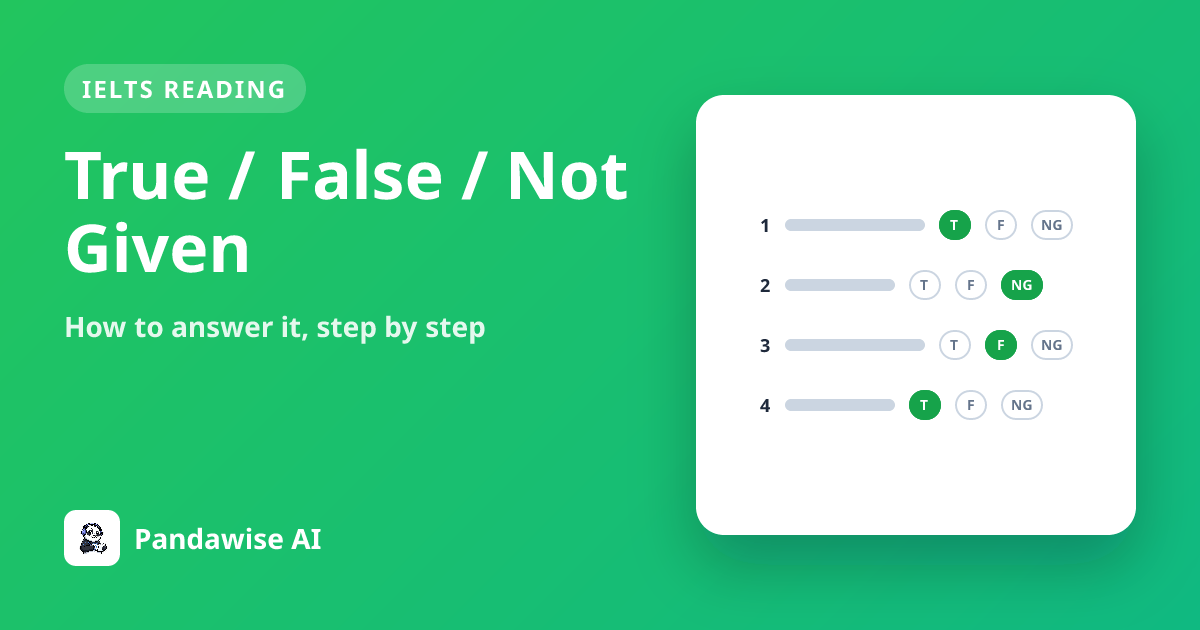
In IELTS Reading True False Not Given questions, you are given a list of statements. You must read the passage carefully and decide for each statement whether it is:
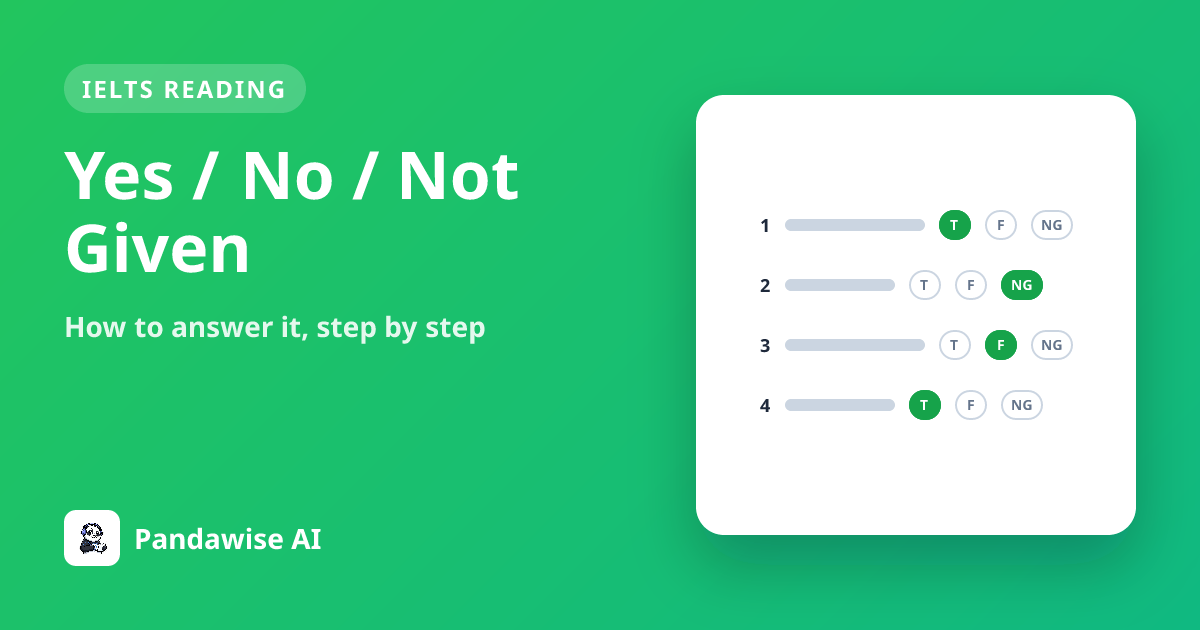
- TRUE – the statement agrees with the information in the passage.
- FALSE – the statement contradicts the information in the passage.
- NOT GIVEN – there is no information about the statement in the passage.
These questions appear in both Academic and General Training Reading. In Academic Reading, you will find them in one or more of the three long passages, which become progressively more difficult. In General Training Reading, they can appear in any section, from the shorter everyday texts in Section 1 to the longer passage in Section 3. The question type is exactly the same in both modules.
It is important to remember that these are about factual information only. They are not about the writer’s opinion. For opinions, you will see a separate question type: Yes / No / Not Given. If you need help with that, see our guide on IELTS Reading Yes / No / Not Given questions.
What Do IELTS Reading True False Not Given Questions Look Like?
On the question paper, the instructions are always in bold. They read:
Do the following statements agree with the information given in Reading Passage 1?
In boxes 1–5 on your answer sheet, write
TRUE if the statement agrees with the information FALSE if the statement contradicts the information NOT GIVEN if there is no information on this
Below the instructions, you will see a list of numbered statements. Here is a realistic example based on a short passage about the history of tea.
The Spread of Tea Cultivation
A. Tea drinking originated in China, where legend says the Emperor Shen Nung discovered the beverage around 2737 BCE when leaves from a wild tea bush blew into his pot of boiling water. For centuries, tea was consumed primarily in East Asia. It was not until the Tang dynasty (618–907 CE) that tea became firmly established as China’s national drink.
B. The first recorded shipment of tea to Europe arrived in Amsterdam in 1610. Initially, it was an expensive luxury item enjoyed only by the wealthy. By the mid-18th century, however, tea had become Britain’s most popular beverage, replacing ale as the everyday drink of the working classes. This shift was encouraged by the East India Company, which imported vast quantities of tea from China.
C. In the 19th century, the British began to cultivate tea in India to break China’s monopoly. The first successful tea gardens were established in Assam in the 1830s, using a native variety of the tea plant that had been discovered growing wild. Soon afterwards, tea cultivation spread to Darjeeling and Sri Lanka. Today, India is one of the world’s largest tea producers, though China remains the single biggest producer overall.
Now, here are five True False Not Given questions based on the passage.
- Tea was first consumed in China during the Tang dynasty.
- Tea arrived in Europe before 1615.
- In Britain, ale was more popular than tea until the 18th century.
- The tea plant grown in Assam was originally brought from China.
- India now produces more tea than China.
The answers will be explained in the worked example section below.
How to Answer TFNG: A Step-by-Step Strategy
A clear strategy saves time and reduces mistakes. Follow these steps for each set of True False Not Given questions.
1. Read the instructions carefully
Always check the exact wording. Confirm that you need to write TRUE, FALSE or NOT GIVEN. On a paper-based test, writing T, F or NG is usually accepted, but the full words are safest. On a computer-based test, you will click your choice from a drop-down menu.
2. Read the statements, not the passage first
Start by reading the first two or three statements. Underline the key words – the nouns, verbs and adjectives that carry the main meaning. Do not read the whole passage yet. This keeps you focused on what you need to find.
3. Scan the passage for the relevant section
True False Not Given answers always come in passage order. This means the answer to question 1 will be found earlier in the text than the answer to question 2, and so on. Use this to your advantage. Scan for the key words you underlined, but remember: the passage will use synonyms and paraphrases, not the same words.
4. Read the relevant sentence(s) in detail
When you find the right part of the passage, read it carefully. Compare the statement word by word with the text. Look for three things:
- Does the passage say exactly the same thing? (TRUE)
- Does the passage say the opposite? (FALSE)
- Is the information simply not there? (NOT GIVEN)
5. Decide on your answer and move on
If you are sure, write your answer and go to the next statement. If you are unsure, mark your best guess and come back later. Never leave a blank – there is no penalty for wrong answers.
6. Manage your time
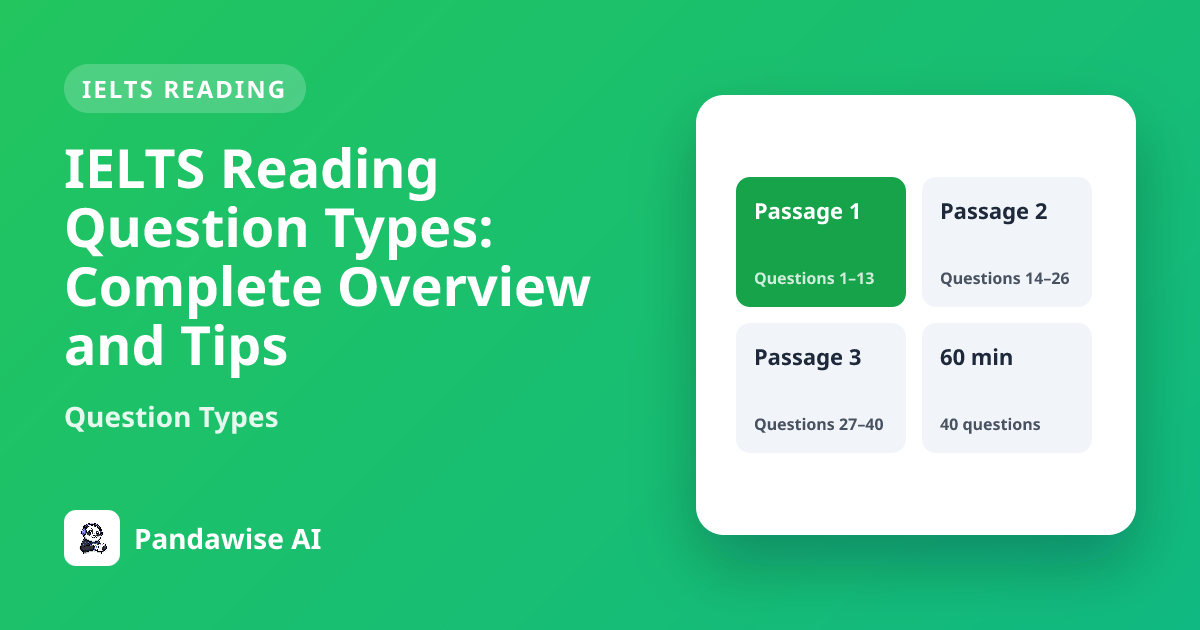
You have 60 minutes for 40 questions across three sections. A rough guide is 20 minutes per section. For a set of five True False Not Given questions, aim to spend no more than 8–10 minutes. If you are stuck on one question, guess and move on.
Worked Example: Explaining Each Answer
Let us go through the sample questions one by one, using the passage above.
Question 1: Tea was first consumed in China during the Tang dynasty.
- Key words: first consumed, China, Tang dynasty.
- Scan the passage: Paragraph A mentions the Tang dynasty. It says, “It was not until the Tang dynasty… that tea became firmly established as China’s national drink.”
- However, the same paragraph earlier states: “Tea drinking originated in China… around 2737 BCE.” This is long before the Tang dynasty (618–907 CE).
- The statement says tea was first consumed during the Tang dynasty. The passage contradicts this: it was consumed much earlier.
- Therefore, the answer is FALSE.
Question 2: Tea arrived in Europe before 1615.
- Key words: arrived in Europe, before 1615.
- Scan the passage: Paragraph B says, “The first recorded shipment of tea to Europe arrived in Amsterdam in 1610.”
- 1610 is before 1615, so the statement agrees with the passage.
- Answer: TRUE.
Question 3: In Britain, ale was more popular than tea until the 18th century.
- Key words: Britain, ale more popular, until the 18th century.
- Scan the passage: Paragraph B says, “By the mid-18th century, however, tea had become Britain’s most popular beverage, replacing ale as the everyday drink of the working classes.”
- This tells us that before the mid-18th century, ale was the everyday drink. So ale was more popular until tea replaced it in the 18th century.
- The statement matches the passage exactly.
- Answer: TRUE.
Question 4: The tea plant grown in Assam was originally brought from China.
- Key words: Assam, originally brought from China.
- Scan the passage: Paragraph C says, “The first successful tea gardens were established in Assam in the 1830s, using a native variety of the tea plant that had been discovered growing wild.”
- The phrase “native variety… discovered growing wild” tells us the plant was local to Assam, not brought from China.
- The statement says it was brought from China, which is the opposite.
- Answer: FALSE.
Question 5: India now produces more tea than China.
- Key words: India, produces more tea than China.
- Scan the passage: The last sentence of Paragraph C says, “Today, India is one of the world’s largest tea producers, though China remains the single biggest producer overall.”
- The passage says China is the biggest producer. This means China produces more than India.
- The statement claims India produces more, which contradicts the passage.
- Answer: FALSE.
Notice how questions 1, 4 and 5 are all FALSE, but for different reasons. Question 1 contradicts the timing, question 4 contradicts the origin, and question 5 contradicts the comparison. In each case, the passage gives clear opposite information.
The Difference Between False and Not Given
The most common difficulty with this question type is the difference between false and not given. Many test takers choose NOT GIVEN when the passage actually says the opposite. Here is a simple rule:
- FALSE: The passage directly contradicts the statement. You can point to a sentence that says the opposite.
- NOT GIVEN: The passage does not mention the key information at all. You cannot find any sentence that confirms or contradicts it.
Consider these examples based on the tea passage:
- Statement: “Tea was first consumed in Japan.” The passage says tea originated in China. It does not mention Japan at all. This is NOT GIVEN.
- Statement: “The first tea shipment to Europe arrived in 1620.” The passage says 1610. This directly contradicts the statement, so it is FALSE.
To avoid confusion, always ask yourself: “Can I find a sentence that says the opposite?” If yes, it is FALSE. If the information is simply absent, it is NOT GIVEN.
Common Mistakes and Traps
Watch out for these common errors when you answer IELTS Reading True False Not Given questions.
- Confusing FALSE and NOT GIVEN: This is the biggest trap. If the statement contains a detail that is mentioned in the passage but in a different way, it is often FALSE. Only choose NOT GIVEN when there is zero evidence either way.
- Matching words, not meaning: The passage will paraphrase the statement. Do not look for the same words. Look for the same meaning. A statement with many words from the passage can still be NOT GIVEN if the overall meaning is not there.
- Ignoring qualifiers: Words like all, some, always, usually, only, first change the meaning completely. If the passage says “some people” and the statement says “all people”, the answer is FALSE.
- Overlooking comparisons and dates: Statements with comparisons (more than, less than) or specific dates are often FALSE or NOT GIVEN. Check the passage carefully for the exact comparison or date.
- Using your own knowledge: The test is about the passage only. Even if you know a statement is true in real life, if the passage does not say it, the answer is NOT GIVEN.
- Leaving blanks: There is no penalty for wrong answers. Always write something. If you run out of time, guess.
- Writing the wrong format: On a paper test, write TRUE, FALSE or NOT GIVEN in full. T, F, NG may be accepted, but full words are safer. On a computer test, select the correct option.
How to Practise IELTS Reading True False Not Given
Regular, focused practice is the best way to improve. Here are some concrete exercises you can do.
- Isolate the skill: Take a short passage (150–250 words) and write your own True False Not Given statements. This forces you to think about what makes a statement true, false or not given.
- Analyse your mistakes: After completing a practice set, do not just check the answers. Go back to the passage and underline the exact words that give the answer. For FALSE answers, highlight the contradictory sentence. For NOT GIVEN, confirm that the information is truly absent.
- Practise with a timer: Give yourself 8–10 minutes for a set of five questions. This builds your speed and confidence for test day.
- Read widely: The more you read in English – newspapers, magazines, academic articles – the better you become at spotting paraphrases and understanding complex sentences.
- Use a variety of question types: True False Not Given questions often appear alongside other types. Practise mixed sets to get used to switching between skills. For an overview of all question types, see our guide on all IELTS Reading question types.
For structured practice with instant feedback, you can try IELTS Reading lessons on Pandawise AI, which offers targeted exercises for this question type.
Key Takeaways
- TRUE means the statement agrees with the passage; FALSE means the passage says the opposite; NOT GIVEN means there is no information.
- The main challenge is the difference between false and not given. Look for a direct contradiction – if you find one, it is FALSE.
- Answers follow passage order, so use this to locate information quickly.
- Pay close attention to qualifiers, comparisons and dates – they often determine the answer.
- Never leave a blank; there is no penalty for guessing.
- Practise regularly with timed exercises and analyse every mistake to understand the logic behind each answer.
Practise true / false / not given questions
Exam-style passages and practice tests with instant marking and the evidence for every answer.
Explore the appFrequently asked questions
What is the difference between false and not given in IELTS Reading?
A statement is FALSE when the passage directly contradicts it. You can find a sentence that says the opposite. A statement is NOT GIVEN when the passage does not mention the key information at all. There is no sentence that either confirms or contradicts it. Always look for a clear contradiction before choosing FALSE.
Can I write T, F, NG instead of True, False, Not Given?
On the paper-based IELTS test, writing T, F, NG is usually accepted, but the full words are safer. The official instructions ask for TRUE, FALSE, NOT GIVEN. On the computer-based test, you simply click your choice from a drop-down menu, so there is no risk of format errors.
Do True False Not Given answers follow the order of the passage?
Yes, the answers to True False Not Given questions almost always come in the same order as the information in the passage. This means the answer to question 1 will be found earlier in the text than the answer to question 2, and so on. Use this to save time when scanning.
How many True False Not Given questions are there in the IELTS Reading test?
There is no fixed number. A typical IELTS Reading test contains 40 questions in total, and True False Not Given questions usually appear as one set of 4–6 questions. They can appear in any of the three sections, in both Academic and General Training modules.
What should I do if I cannot find the answer to a True False Not Given question?
If you cannot find any information after scanning the relevant part of the passage, the answer is likely NOT GIVEN. However, double-check that you have not missed a paraphrase. If you are still unsure, make your best guess and move on. Never leave a blank, as there is no penalty for wrong answers.