Question Types
IELTS Reading Multiple Answers: Tips, Strategy and Example
Learn how to tackle IELTS Reading multiple choice questions with more than one answer. This guide covers a clear strategy, a worked example and common mistakes to avoid.
Pandawise AI · Updated · 11 min read
In this guide
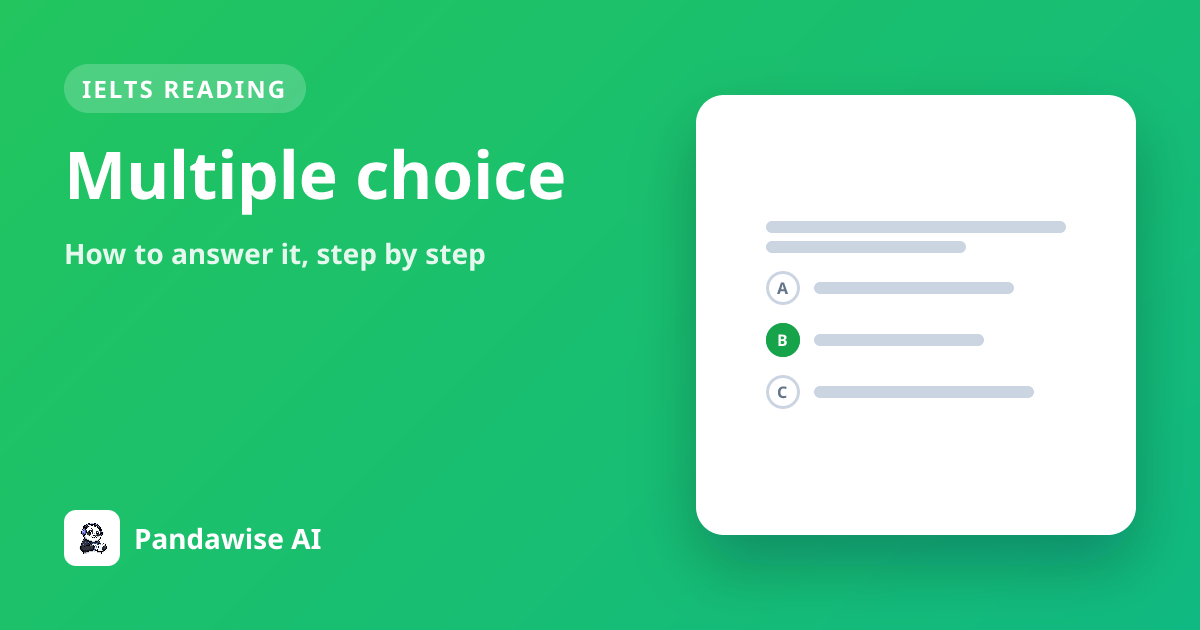
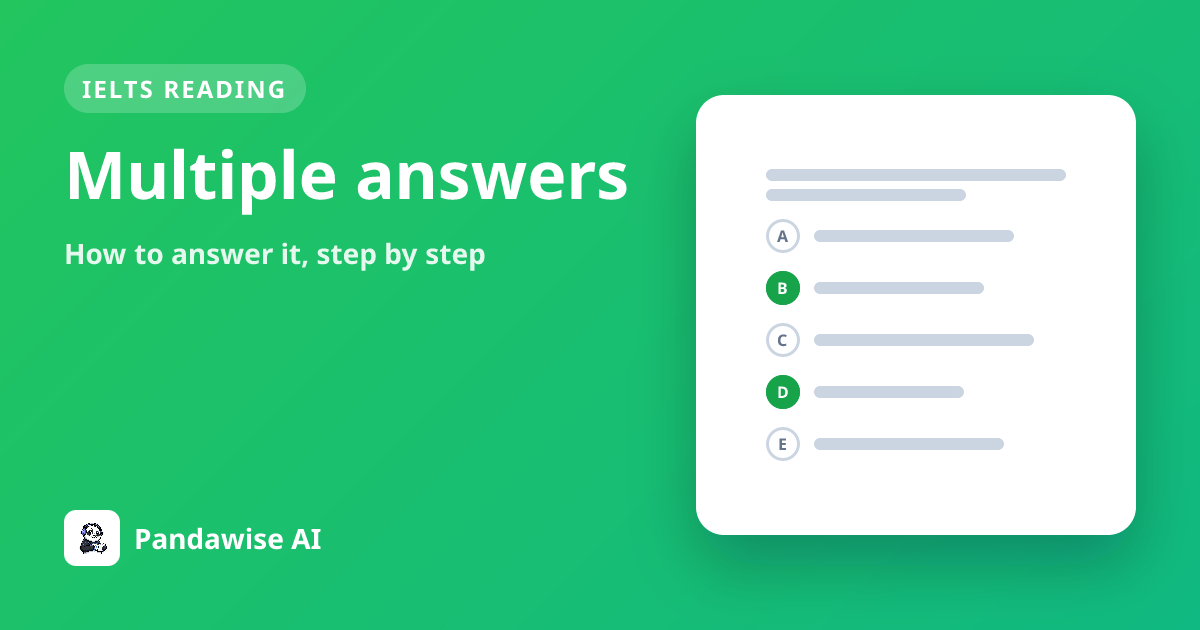
IELTS Reading multiple choice questions with more than one answer ask you to choose TWO letters from a list of options, usually A–E. In some cases, you may need to choose THREE letters from a longer list. This question type appears in both Academic and General Training modules and tests your ability to identify specific information, understand detail and distinguish between similar ideas. The relevant information may be spread over a paragraph or even across several paragraphs, so you need to check each option carefully against the passage. Each correct letter scores one mark, and the letters can be written in either order on the answer sheet.
What are IELTS Reading multiple answers questions?
In IELTS Reading multiple answers tasks, the instructions ask you to select two correct answers from a set of five or more possibilities. This is a variation of the standard multiple choice question, but instead of finding one correct answer, you must find two. The questions test your ability to scan for specific information, understand paraphrased ideas and eliminate distractors. They often appear in passages that describe lists, causes, effects, characteristics or categories. In Academic Reading, you might see them in any of the three passages, while in General Training Reading they are more common in Section 3, where you deal with a longer, more complex text. The task is worth two marks in total, and you get one mark for each correct letter you write on the answer sheet.
What the questions look like
The instructions are always in bold and read exactly like this:
Questions 1 and 2
Choose TWO letters, A–E.
Write the correct letters in boxes 1 and 2 on your answer sheet.
Which TWO of the following are mentioned in the passage as benefits of urban green spaces?
Below this, you see five options labelled A to E. You must select the two that are directly supported by the passage. Here is a realistic sample passage and questions.
The role of urban green spaces
A. Urban green spaces, such as parks, gardens and tree-lined streets, have long been valued for their aesthetic appeal. However, research now shows they provide a range of less obvious benefits that can improve the quality of life in cities. One of the most significant is their ability to reduce air pollution. Leaves and branches trap particulate matter and absorb gases like carbon monoxide, helping to clean the air we breathe.
B. Another important function is temperature regulation. In built-up areas, concrete and asphalt absorb heat during the day and release it at night, creating what is known as the urban heat island effect. Green spaces counteract this by providing shade and through the process of evapotranspiration, where plants release water vapour into the air. This can lower local temperatures by several degrees.
C. Green spaces also contribute to physical health by encouraging exercise. People are more likely to walk, jog or cycle if attractive, safe routes are available. In addition, studies have linked access to nature with reduced stress levels and improved mental wellbeing. Even a short time spent in a park can lower blood pressure and boost mood.
D. There are social benefits too. Parks and community gardens bring people together, fostering a sense of belonging. They provide venues for events, informal gatherings and children’s play, which helps to build stronger neighbourhood ties. Some research even suggests that areas with more green space experience lower crime rates.
E. Finally, green spaces can support urban wildlife. Birds, insects and small mammals find food and shelter in these habitats, which is increasingly important as natural areas are lost to development. This biodiversity not only has ecological value but also enriches the experience of city dwellers.
Questions 1 and 2
Choose TWO letters, A–E.
Write the correct letters in boxes 1 and 2 on your answer sheet.
Which TWO of the following are mentioned in the passage as benefits of urban green spaces?
A. They make cities look more attractive. B. They help to remove pollutants from the air. C. They increase the amount of rainfall in cities. D. They can strengthen community relationships. E. They provide employment for local residents.
Step-by-step strategy for multiple answers questions
Follow this numbered strategy to approach IELTS Reading multiple answers tasks efficiently and accurately. Each step builds on the previous one and helps you manage your time within the 60-minute test.
1. Read the question stem carefully
Before you look at the options or the passage, read the question stem to understand exactly what you are looking for. In the sample, the stem is: “Which TWO of the following are mentioned in the passage as benefits of urban green spaces?” The key words are “benefits” and “urban green spaces”. This tells you to search for positive outcomes related to parks and similar areas. Underline or mentally note these key words.
2. Skim the passage for the relevant section
Because the information may be spread over more than one paragraph, do not read the whole passage in detail. Instead, quickly skim the text to locate where the topic of benefits is discussed. In our sample, the entire passage is about benefits, but in a real test, you might need to find the right section. Look for synonyms of “benefits”, such as “advantages”, “positive effects” or “functions”. Once you have found the relevant area, you are ready to scan the options.
3. Read the options and underline key words
Read options A to E and underline the main idea in each. For example:
- A: look more attractive
- B: remove pollutants from the air
- C: increase rainfall
- D: strengthen community relationships
- E: provide employment
This step helps you hold the ideas in your mind as you scan the passage. Do not try to match words exactly; expect paraphrasing.
4. Scan the passage for each option in turn
Take one option at a time and scan the relevant paragraphs for evidence. Look for synonyms and paraphrases. For option A, “look more attractive”, scan for words like “aesthetic”, “beauty” or “visual appeal”. In paragraph A, you find “valued for their aesthetic appeal”. This is a match, so A is a possible answer. However, the question asks for benefits “mentioned in the passage”, and the passage says they have “long been valued” for this, but it is not presented as a new benefit discovered by research. You need to check if the passage treats it as a benefit or just as a known fact. This is a common trap, which we will explore later.
5. Eliminate clearly wrong options
Cross out options that the passage contradicts or does not mention at all. For option C, “increase rainfall”, the passage mentions evapotranspiration but does not say it increases rainfall; it says it cools the air. So, C is not mentioned and can be eliminated. For option E, “provide employment”, there is no mention of jobs anywhere in the passage. E is also wrong.
6. Confirm the two correct answers with exact evidence
For the remaining options, find the exact words in the passage that support them. For option B, paragraph A states: “their ability to reduce air pollution. Leaves and branches trap particulate matter and absorb gases like carbon monoxide, helping to clean the air we breathe.” This clearly paraphrases “remove pollutants from the air”. For option D, paragraph D says: “Parks and community gardens bring people together, fostering a sense of belonging … helps to build stronger neighbourhood ties.” This matches “strengthen community relationships”. Therefore, B and D are the correct answers.
7. Write the letters on the answer sheet
Write the letters B and D in boxes 1 and 2 in any order. Remember, you must transfer your answers directly onto the answer sheet within the 60 minutes; there is no extra time. Double-check that you have written the letters clearly and that they match the options you have chosen.
Worked example: finding the two correct answers
Let us work through the sample questions in detail, showing exactly why each answer is right or wrong.
Question: Which TWO of the following are mentioned in the passage as benefits of urban green spaces?
Option A: They make cities look more attractive.
- Passage evidence: Paragraph A says “have long been valued for their aesthetic appeal”.
- Analysis: The phrase “aesthetic appeal” is a synonym for “look more attractive”. However, the passage introduces this as a long-held view, not as one of the benefits revealed by research. The question asks for benefits “mentioned in the passage”, and this is mentioned. But is it presented as a benefit? The passage’s focus is on “less obvious benefits”, and aesthetic appeal is the obvious one. In many IELTS questions, the correct answers are the ones that align with the main point the writer is making. Here, the writer downplays aesthetic appeal to highlight other benefits. Therefore, while it is mentioned, it is not one of the answers the question is targeting. In the context of the whole passage, A is a distractor.
Option B: They help to remove pollutants from the air.
- Passage evidence: Paragraph A: “their ability to reduce air pollution. Leaves and branches trap particulate matter and absorb gases like carbon monoxide, helping to clean the air we breathe.”
- Analysis: “Reduce air pollution” and “clean the air” directly paraphrase “remove pollutants from the air”. This is clearly stated as a benefit. B is correct.
Option C: They increase the amount of rainfall in cities.
- Passage evidence: Paragraph B mentions “evapotranspiration, where plants release water vapour into the air”, but this is linked to cooling, not rainfall.
- Analysis: The passage does not say that this water vapour leads to rain. The idea of increased rainfall is not supported. C is incorrect.
Option D: They can strengthen community relationships.
- Passage evidence: Paragraph D: “bring people together, fostering a sense of belonging … helps to build stronger neighbourhood ties.”
- Analysis: “Strengthen community relationships” is a clear paraphrase of “build stronger neighbourhood ties” and “foster a sense of belonging”. This is presented as a social benefit. D is correct.
Option E: They provide employment for local residents.
- Passage evidence: None. The word “employment” or any synonym does not appear.
- Analysis: The passage does not mention jobs. E is incorrect.
Therefore, the correct answers are B and D.
Common mistakes and traps
- Choosing options that are true but not mentioned: You might know from your own knowledge that urban green spaces provide employment, but if it is not in the passage, it cannot be the answer. Always base your answer solely on the text.
- Falling for exact word matches: Sometimes a distractor uses words directly from the passage but in a different context. For example, an option might say “water vapour cools the air” (true), but if the option says “water vapour increases humidity”, it might be wrong if humidity is not discussed. Check the meaning, not just the words.
- Selecting only one answer: Some candidates find one correct answer and stop looking. Remember, you must choose two letters. Even if you are unsure about the second, make an educated guess; there is no penalty for wrong answers.
- Misinterpreting the question scope: If the question asks for “benefits”, make sure the option describes a positive outcome. A statement that is simply a fact about green spaces may not be a benefit.
- Ignoring paraphrasing: The passage and options use different words. If you look for the same words, you will miss correct answers. For example, “strengthen community relationships” is paraphrased as “build stronger neighbourhood ties”. Train yourself to spot synonyms.
- Writing the letters in a specific order: The instructions say you can write the letters in any order. Do not waste time deciding which to put first; just write them clearly.
How to practise multiple answers questions
Regular, focused practice is essential to master multiple answers IELTS Reading tasks. Here are some concrete exercises you can do.
- Create your own questions: Take a short article (200–300 words) and write a list of five statements about it, two of which are true according to the text. Then try to answer them after a day or two. This helps you understand how distractors are constructed.
- Paraphrase hunting: In any reading text, underline key ideas and then write them in your own words. Compare your paraphrases with the original. This builds the skill of recognising synonyms quickly.
- Timed scanning drills: Set a timer for two minutes. Read a question stem and a list of options, then scan the passage to eliminate wrong options. Do not worry about finding the correct answers at first; just practise crossing out the ones that are clearly wrong.
- Work with a study partner: One person finds a passage and writes a multiple answers question. The other answers it, and then you discuss the evidence. Explaining your reasoning helps you avoid common traps.
- Use online practice platforms: You can practise this question type and all other IELTS Reading tasks with realistic passages and instant feedback on IELTS Reading lessons. This allows you to test your skills under timed conditions and review detailed explanations.
For a broader understanding of the test, see our guide on all IELTS Reading question types. If you want to focus on other multiple choice formats, check out IELTS Reading multiple choice questions (one answer).
Key takeaways
- In IELTS Reading multiple answers questions, you must select two correct options from a list of five or more, and each correct letter scores one mark.
- The information may be spread across one or more paragraphs, so scan the passage for the relevant topic before checking each option.
- Always eliminate options that the passage contradicts or does not mention, and confirm your answers with exact evidence from the text.
- Beware of distractors that use words from the passage but change the meaning, or that state true facts not mentioned in the text.
- Practise paraphrasing and timed scanning regularly to improve your speed and accuracy.
- Remember to write the letters in any order on the answer sheet within the 60-minute time limit; there is no extra transfer time.
Practise multiple answers questions
Exam-style passages and practice tests with instant marking and the evidence for every answer.
Explore the appFrequently asked questions
How are IELTS Reading multiple answers questions scored?
Each correct letter scores one mark, so the task is worth two marks in total. You can write the two letters in any order on the answer sheet. If you only write one correct letter, you get one mark; if you write one correct and one incorrect letter, you still get one mark for the correct one. There is no penalty for wrong answers, so always guess if unsure.
Can I write the letters in any order on the answer sheet?
Yes, the instructions state that you can write the letters in either order. The examiner will mark both answers regardless of which box they appear in. Just make sure the letters are clear and match the options you have chosen. Do not waste time deciding which to write first.
What is the difference between multiple answers and regular multiple choice in IELTS Reading?
Regular multiple choice questions ask you to select one correct answer from three or four options. Multiple answers questions ask you to select two correct answers from a list of five or more options. The latter often requires you to find information spread over a wider part of the passage and tests your ability to identify multiple correct points.
How can I avoid choosing a distractor in multiple answers questions?
Always check the exact meaning of the option against the passage, not just individual words. Distractors often use words from the text but in a different context or with a different meaning. Eliminate options that are not mentioned or are contradicted, and confirm each correct answer with a direct paraphrase from the passage.
Do the answers come in order in the passage for multiple answers questions?
Not necessarily. The two correct answers may be found in different parts of the passage and not in the order of the options. You need to scan the whole relevant section for each option individually. This is different from some other question types where answers appear in passage order.